AR-15 Review: Wilson Combat 6.8
Categories:: Gun Reviews • Rifles • Tactical Guns
Patrick Sweeney | Jan 22, 2013 | Comments 1

Add to favorites
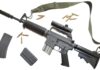
One of the Wilson 6.8 rifles, here with an Aimpoint M4 on it. You’ll note that the Wilson BUIS doesn’t crowd the Aimpoint, and when it flips up the Wilson BUIS won’t bang the M4.
If you spend any time at all in a competitive endeavor, you’ll quickly realize that skill at any given contest does not necessarily carry over to another. The list of professional ballplayers (football, baseball, whatever) who were good on the field, and then good as a coach, is small. The list of professional sports figures who go on to open successful businesses is small, indeed.
Skill in any endeavor is a rare thing. We should expect, therefore, that skill in two would be rarer still. Which is one of the things that makes Bill Wilson rare. Were I given to the usual sloppy hyperbole that modern writing schools seem to encourage so much, I’d call him unique. He isn’t. As good as he is, he isn’t the only one to be successful as a businessman in the field in which he saw such fame as a competitor. And make no mistake, he was a heavyweight back in the early days of IPSC, and he’s a heavyweight now in the field of custom guns.

The folding Wilson front sight, which blends in nicely with the top rail of the free-float Wilson handguard.
Starting with 1911s, Bill has expanded to the modern triumvirate of defensive artillery: the 1911, the 870, and the AR. Wilson ARs are built on 7075-T6 forgings, precision machined (and in this day and age that means CNC multi-axis machines) and hard-coat anodized. The receivers are then given a Wilson Armor-Tuff baked-on epoxy finish, in your choice of green, black, tan, gray or stainless, depending on the model. They all have Wilson match-grade barrels, 16, 18 or 20 inches, depending on what model you choose. The smallbores have 5.56 chambers for reliable chambering and to avoid the problems that .223 chambers can bring when fed a diet of 5.56-spec ammo.
As with his 1911s, you can get a standard, Wilson-spec rifle: just pick the catalog number, phone or email your order, and your FFL will be receiving it in short order. Or you can custom-build the AR of your heart’s desire by starting with a Wilson model and substituting items such as flash hiders (Vortex, A2 or Wilson Tactical Muzzle brake?), stocks (Magpul or M4?), folding sights (Wilson makes a handful, front and rear), and your choice of railed handguard – and do you want low-profile rail ladders, or full-profile rail covers?
Scope mounts, optics, pistol grips, charging handles, bolt releases, foregrips, all can be spec’d and either left as-is or Armor-Tuff® coated to match.
But you knew all that, right? I mean, you’re an AR fan who stays in the know, so none of that is news to you. Well, guess again; Wilson is now making rifles in 6.8.
Developed to provide a significant increase in terminal effectiveness without making recoil onerous, the 6.8 Remington SPC is a big step up. If you want a rifle chambered in a cartridge a lot more suited to hunting (and it will pass muster even in States where the DNR does not allow .223/5.56 for deer hunting) while being the modern, reliable, and accurate rifle of the 21st century, the 6.8 is a good choice. The Wilson 6.8 project simply takes the already-excellent Wilson AR and replaces the 5.56 parts with 6.8.
Related Posts:
About the Author: Patrick Sweeney is the author of many of Gun Digest books' best-selling titles, including Gun Digest Book of the 1911, Vols. I & II; Gun Digest Big Fat Book of the .45 ACP, Gun Digest Book of the AR-15, Gun Digest Book of the AK and SKS, Gun Digest Book of the Glock and Gunsmithing: Pistols and Revolvers, among other titles. A master gunsmith, Patrick is also Handguns Editor for Guns & Ammo magazine.


Same old advertisement hype: Newer is better, run out and get two right away.
Competitive shooters I have interviewed tell me that the 6.8 and 6.5 clones are actually less accurate than the standard .223.
How about lethality? Since the days of the king of charlatans “Elmer Keith”, who beat the big bore drums for years, the public has been brain washed into believing such hog wash. Real hunters have known for the last century that bullet diameter is quite meaningless. Shot placement and penetration are what counts the most.
Real hunters of yesteryear like Jack O’Connor, Agnes Herbert, W.D.M.Bell and a host of others proved beyond doubt that small bore rifles with long heavy bullets penetrated far better than slower moving less penetrating big bore calibers. Roy Weatherby once stopped a charging African Buffalo with one shot from a .240 Weatherby. W.D.M.Bell who used big bore and small bore guns reported only his 6.5mm was able to consistently shoot right through an Elephants skull. He should now as he shot over 1,000 elephants, far more than Keith’s one or two.
The .223 when used with the long heavy bullets has plenty of penetration and lethality and it does it with less recoil and the ability to carry more ammo. The only the thing the U.S. military should do is scrap the AR-15 system as it is one of the most unreliable military rifles of all time, it stands shoulder to shoulder with the horribly unreliable WWI French Chauchat. I could also mention the Rashid and others like it that used the same unreliable gas impingment system the AR-15 uses.