

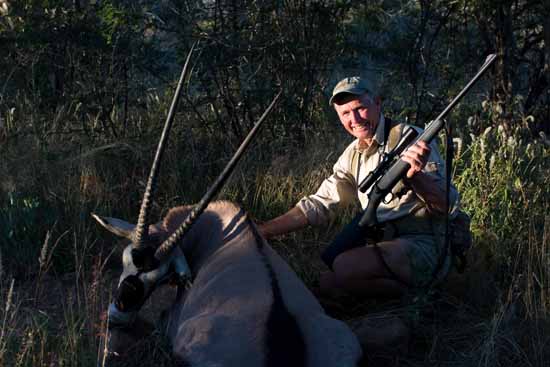
Big game that drops instantly to a shot is cause for concern.
Bullets don’t hurl animals to earth; an immediate collapse usually mean you’ve struck the spine. A severed spinal cord anchors the beast. If your bullet has also sent fragments through the chest or so shattered the forward spine as to deliver fatal shock, you won’t have to fire again.
Without knowing that, you’d best cycle the bolt and ready yourself for another shot. Bullets that strike spinal processes – those short appendages on vertebrae – also deliver a hammer-like blow. But the animal can recover, sometimes within seconds. Once it regains its feet, you’ll likely not bag it unless another hit follows, pronto.
You can expect reaction to both bullet strikes and near misses. If the buck doesn’t react instantly, you probably missed. A bullet arrives faster than you can get your scope back on target, and the reaction is involuntary. If you see the deer duck, and it runs with tail up, it is likely unscathed. A deer that stands as if puzzled by the blast and sonic crack is almost surely untouched. Sudden noise can be hard to place; animals often pause, to determine a safe exit.
Up close you’ll seldom see the eruption of hair, dust or water, the flinch, the caving to the blow when your bullet lands. The violence of recoil will obscure all.
At distance, depending on light conditions, bullet velocity and your recovery time, you will. The sound of a strike follows reaction to the hit. A .270 bullet leaving at 3,000 fps averages about 2,700 fps over its first 300 yards. It reaches a deer 300 yards away in a third of a second. The thud of impact takes a second ambling back. You’ll hear the hit about 1 1/3 seconds after you fire.
The solid “thwuck” of a bullet through front ribs is welcome music. A sharp “whock” means you struck big bone; a sodden, splashy, hollow landing means a paunch hit.
Always assume a hit. Always reload quickly. Excepting offhand shots up close in timber, I stay in shooting position for at least 10 seconds after a shot. If game appears after the shot, I make sure it is the same animal before firing again.
Always check if you suspect a miss. First, flag your shooting spot and the place where the animal was when you fired (I carry ribbon for this purpose). Many deer are lost because hunters don’t follow up intelligently after the shot. Blood may not appear on the trail for many yards, even if the damage is lethal. I’ve found dead deer and elk many yards from where they were hit and had to back-trail to see any blood. A bullet that doesn’t pass through may cause lots of internal hemorrhage, only to have elastic hide slip over the entry hole during escape, impeding leaks.
Once, after calling a good shot at a deer in open woodland, I watched it gallop off at an even and deliberate pace. I followed the hoofprints but found no blood. Returning to the site of the hit, I got down on hands and knees, searching in circles. A tiny pink pellet with a single deer hair caught my eye. Lung.
Carefully, I worked my way along the trail again. This time I found a drop of blood. At a turn in the trail, I spied a track I’d missed before. The buck lay a few steps farther on.
Game commonly makes an abrupt turn just before collapsing. A buck I hit too far back slipped into dense willows. I followed on hands and knees as the vegetation pressed in. There was no blood; it seemed as if the earth had swallowed this deer. Then I spotted a small gap to the side of what was now just a rabbit’s path. I crawled through it – and onto the carcass of the buck.
Perseverance is an asset. You might also call it a requisite. When you fire at big game, you have the responsibility to follow up. Some years ago, guiding a mule deer hunter, I spied a buck across a draw.
My client decided to shoot. The deer ran immediately. “Aw, I probably missed,” said the man, obviously not keen to cross the rugged draw and spend time on the deer’s trail. I insisted, though, and presently we stood where the animal had. “See, no blood.”
My companion wanted to start hunting again. I left him at the site and tracked the deer into timber, where I found it dead.
Lethal hits don’t always put game down immediately. In fact, most of the animals I’ve shot have moved before dropping. Regardless of the reaction, I always check and follow. As do all sportsmen.
Classics by Wayne van Zwoll 

Mastering the Art of Long Range Shooting
Wayne van Zwoll's The Technical Rifleman
Gun Digest Shooter's Guide to Rifles

Even a killing shot, through the heart, may leave the target moving. In the article at https://www.rrmemphis.com/myth.pdf, the authors describe the human brain sending sending signals to the muscles for up to 10 seconds after the heart has stopped. How far can game move in 10 seconds?
I have shot numerous elk over the years, and have found that no reaction to the shot is fairly common. I shot a cow at about 80 yards a few years back, and while I was confident of the hit, she simply stood there and looked at me. I was getting ready to shoot again as she calmly walked away. About 10 paces and she just tipped over dead. The bullet, 165gr .308 partition from a 30-06, had gone between two ribs on both sides, through both lungs, and the top of the heart. I shot my first elk, a raghorn bull at about 300yd M/L at a steep uphill angle with a 375H&H. He also walked off as if I missed clean. Again,I was pretty sure of the shot, so I followed up, he walked about 50 or so yards and dropped dead. I have seen it happen many more times on deer and elk.