
One shot does not a marksman make. Neither does it demonstrate accuracy. A single hole, in an animal or a paper target, shows only that you fired the rifle. It takes more to achieve true marksmanship.
During the iron-sight stage of a smallbore match years ago, I settled into prone and accidentally brushed the trigger. Dismayed, I hardly dared peek into the spotting scope. The best I could hope was that the bullet had missed the paper, leaving no evidence a shot had been fired. A hole in any of the 10 record targets, or between them, would affect my score.
Squinting into the glass, I was astounded to see a hole in the center of the target I was to shoot. A pinwheel. That shot had nothing to do with my marksmanship or the accuracy of the rifle or ammunition.
In its purest form, accuracy is a measure of consistency.
Standards of accuracy can change over time, as they vary with conditions and shooting gear. Marksmen obsessed with accuracy have developed games and equipment that re-define the term. The first official benchrest match, held in Johnstown, New York in 1947, drew international interest. Special rifles and loads, and better optics, have since enabled shooters to print tiny groups.
In the UK not long ago, a sharp-eyed shooter drilled a .135-inch five-shot group at 100 yards and a 6.908 group at 1,000 yards under trying conditions. The world’s record 1,000-yard group measures inside 2 inches, well under a quarter minute of angle.
Hunting rifles and ammunition have improved a great deal since I started shooting. When you could buy one at retail for $89.50, we considered the 94 Winchester a 3-minute rifle.
Now, with Hornady LeverEvolution ammo, the best .30-30 lever guns punch 1-minute groups. When it appeared, the M-16 rifle couldn’t match the accuracy of the M-14 or the Garand. Now, after many refinements, a tuned AR-15 shoots about as well as competitive bolt-actions.
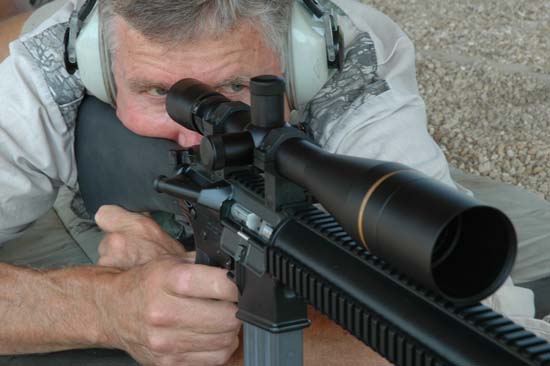
Recently, I fired a Les Baer AR with Federal ammunition launching 77-grain Sierra MatchKings. Sub-minute groups came easily, and one three-shot cluster measured less than half an inch at 200 yards.
In my youth, hunters marveled at rifles that shot into a nickel at 100 yards, but they didn’t despair if the groups were bigger. Many marksmen still relied on iron sights, and big game was shot close. These days, interest in tactical rifles, rangefinding devices, high-power scopes and long-range shooting has nudged the accuracy bar ever upward. While smart hunters get as close as possible for shots at game, long-distance hits on paper targets and steel are confidence-builders.
Accuracy at distance makes you more successful in competition and afield. When you can hit far away, the close shots seem easier.
To that end, manufacturers of rifles, barrels, scopes and ammunition have poured many thousands of dollars into new products. Darrell Holland (hwww.hollandguns.com), who runs a shooting school in southern Oregon and builds super-accurate rifles, has designed a unique scope reticle for long shots. A series of ballistics cards from Holland help you quickly assess effects of range, wind and shot angle for your favorite load.
In the same way, the fellows at Greybull Precision (greybullprecision.com) manufacture scope dials for specific loads and fit them to Leupold scopes with cleverly designed reticles. I’ve used Greybull scopes to 780 yards, banging minute-of-angle groups on steel with center holds. A Marlin lever-action printed six first-round hits inside a 10-inch circle from 100 to 600 yards, with center aim. All I did between shots was adjust the Greybull dial for distance. Matching of scope dials to specific bullet arcs has since become a service of most scope-makers.
Ballistics software from Sierra, Nikon and other sources has not only fueled interest in long-range shooting but given riflemen tools to do it. Knowing where to aim or how to adjust the sight at distance is a first step to hitting consistently.
Marksmanship comes next. Holding the rifle still and executing the shot properly is a skill independent of equipment. It is also the pivotal factor in the pursuit of accuracy.
Technical Rifleman Digital Download
 Did you enjoy this blog post? Now is your chance to own Wayne van Zwoll's entire article series — The Technical Rifleman. The entertaining and informative blog ran for a year on GunDigest.com, but was a lifetime in the making. The articles tap into the renown gun writer's limitless knowledge of rifles and shooting, covering a wide range of topics, from picking the right rifle scope to figuring out a gun's recoil. The Technical Rifleman is certain to round out any rifle enthusiast's library. Pick up yours today!
 Buy the Kindle version of The Technical Rifleman here!