
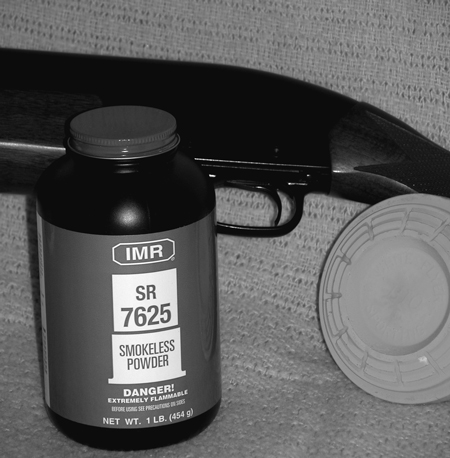
One hears about several types of shotshell pressure, but for handloading there is only one pressure that you truly need to understand, service pressure.
SAAMI has organized US gun manufacturers to adhere to a set of standards for service pressure, and all modern models of guns made in the US are proofed or tested to make sure they withstand these pressures.
Service pressure is predicated on the diameter of the bore (its gauge) and the length of the chamber (in inches). It is understood that the standard gives you a tiny bit of leeway to make a mistake in handloading. If you exceed the service pressure with a load delivering 10 or even 100 fps greater than load data suggests is correct, your load will probably perform just fine and your gun will be safe. For your own sake though, you should consider the service pressure to be an inflexible ceiling.
By saying that service pressure gives you some leeway, I mean that it is purposefully fudged. SAAMI does not discuss this “fudge factor” in public, but it is perhaps as little as 10- to as much as 25-percent above the advertised service pressure. Still, this number is much lower than what is called “proof pressure.”
Proofing is an electro-mechanical process of testing barrels to be sure that they will withstand normal shooting for hunting or competition. It involves firing super-hot, high-pressure shells (heavy shot and slow-burning powders) and then measuring their effects in a barrel. Normally, manufacturers test shotguns with one or two proof rounds and then carefully examine the barrels for damage. You may be certain that any modern barrel has been carefully proofed to keep you safe, keep your pellets in the vicinity of the target and minimize the possibility that any shooter will be injured.
After proofing, barrels are customarily stamped with a particular indentation that indicates they have been tested. Proof stamps are the kind of minutiae that fascinates students of shotgunning, in part because the stamps of foreign “proof houses” are interesting for their variety and intrinsic history. Americans, who are typically more casual with their sense of tradition, commonly neglect such attention to detail preferring instead to concentrate on the shooting characteristics of their guns and loads as tools rather than heirlooms, means to an end rather than the end in itself.
Chances are that you will never see a shell marked for proofing, but if you do, it will bear a conspicuous label (“Danger – High Pressure”) and may, in addition, be clearly marked as a proof load. If you do see such a shell, do NOT attempt to fire it through your personal gun. A proof load generates pressures far in excess of the accepted service pressure.
If you are shooting a 12-gauge Remington 1100 chambered for 2-3/4-inch shells, the maximum SAAMI service pressure standard is 11,500 psi. The SAAMI proof pressure for this popular gas gun on the other hand is achieved with a load of 1-1/2-ounces of shot and measures between 19,000 psi and 20,500 psi, practically twice the service pressure. Not only would repeated firing of that level of pressure damage your gun, but its recoil would probably knock you off your feet.
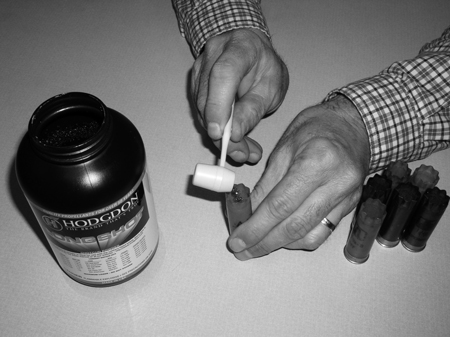
SOME SHOTSHELL PRESSURE PROBLEMS
Loss of pressure during the burning cycle diminishes any chance of a complete and efficient powder burn. The result is shot pellets without the energy or velocity you normally expect and a greater build-up of crud in your barrel.
A small interruption could be a collapsed gas seal, for example. Inconsistent pressures and velocities are the clues that your load components may be breaking down. Irregularities in the pressure curve, perhaps caused by a component shift, reduce the effectiveness of the propellant burn because compression momentarily slackens.
These unpredictable component shifts have several identifiable origins: weak cushion sections in wads, weak seals or worn-out hulls with poor crimps.
Many substandard loads sound fine when they are fired, but compared to a more perfect load, actually produce inferior velocity and energy delivery. If your load experiences a loss of pressure, even a minute loss, pellets may be getting out there, but not with the speed and energy you expect.
It may surprise you to learn that shotshells are designed to operate at the low end of the powder-pressure spectrum. All powders, particularly those that burn slowly, are sensitive to compression and with improper or leaky containment, burning will inevitably be less than complete. It is also true that a lighter than average load may reduce your chamber pressure to a point where the proper burning cycle cannot be concluded.
What do you do when you pull the trigger on a reload and the gun seems to fire, but without its customary authoritative kick? You may have an obstruction in the barrel caused by a faulty load. Stop immediately and, with the barrel pointed downrange, perform a visual inspection. It is possible that the wad has lodged inside. If you fire another round behind and into it, the resulting traffic jam in the bore can cause a permanently ruptured barrel and could hurt you and those around you.

FIRE IN THE HOLE!
So, what happens when you pull the trigger? The powder is ignited. It begins combining furiously with its own oxygen to create an ever-expanding column of ultra-hot gas, but at a constant pressure (for maximum pellet velocity), and that column takes up an increasing volume of space. This is what pushes the shot out toward the flying pigeon. When the shotcup leaves the barrel, air resistance causes it to fall away within about 10 yards, and the speeding shot rushes on toward its intended target, although its velocity begins to diminish immediately upon exiting the barrel.
The column of hot gas is engineered to balance the burning powder with the expanding volume. Hence, powders are grouped by “burn rates.” If all of the powder burns before the shot passes the forcing cone, the shot may begin slowing down inside the barrel and that, obviously, is not going to give you the perfect solution to any shooting problem. Here are the generally accepted guidelines, but remember that engineers develop loads for practically every possible combination and circumstance, so these are only “rules of thumb”:
- Lightweight loads with moderate velocity, typically target and small game loads, fall into a faster burning powder category. (Example: Introduced in 1992, Hodgdon’s Clays “produces soft, smooth recoil, ultra clean burning, mild muzzle report and excellent patterns.”)
- Heavier hunting loads, which typically have greater velocities, predominantly use slow-burning powders. (Example: Introduced 85 years ago, Alliant’s Herco is a “proven powder for heavy shotshell loads.”)
Powder burn rates are important. Many hunters endure the foulest, coldest weather to hunt deer or waterfowl, and our Canadian cousins revel in organizing sporting clays events when orange birds show up remarkably well against mounds of snow and ice. With an already slow-burning powder, low temperatures can cause a problem on a frigid morning in a Maryland duck blind.
We know that cold retards ignition and causes powder to burn slower. To optimize your shotgun’s performance in these conditions, you need specially constructed loads perhaps upgrading to a medium burn rate powder. You may also want to consider using heavier loads and new hulls for stronger crimps. Hot primers are more likely to cause good powder ignition in cold weather because they were developed for just such a situation.
This is precisely why handloading is such a virtuous pastime for shotgunners. It allows us to craft loads for conditions, and to laugh at our over-the-counter buying cousins. Different recipes will give you different results and you can load differently for hot days than for cold days. (To be honest, even experienced shotgunners usually cannot perceive any difference in their load performance as temperature changes, but they are aware that there is a difference.).
Although they do for the most part list velocities for over-the-counter shells, ammunition companies do not publish pressures for their commercial loads in either their catalogs or on their Internet sites. Ammo manufacturers are often stingy about revealing the amount of powder in loads as well, preferring simply to list that number (that number being the relatively archaic “drams equivalent”) as “max.” Of course, there may be a good reason for this.
This article is an excerpt from Reloading for Shotgunners, 5th Edition. Click here to learn more or get your copy.

Next Step: Get your FREE Printable Target Pack
Enhance your shooting precision with our 62 MOA Targets, perfect for rifles and handguns. Crafted in collaboration with Storm Tactical for accuracy and versatility.
Subscribe to the Gun Digest email newsletter and get your downloadable target pack sent straight to your inbox. Stay updated with the latest firearms info in the industry.



Can you recommend a safe load for my 1889 Remington grade 1 “fluid steel barrel” side-by-side (rebored to 2 3/4″) using a plastic case and wad ?