
AR-15 Pistons: Pros & Cons
Categories:: Tactical Gear • Tactical Guns
Patrick Sweeney | Sep 12, 2012 | Comments 3

Add to favorites
Click here for a free AR-15/M16 Gas Piston Conversion Kit Primer download. It covers how the AR-15 direct impingement system works, advantages of the AR-15 piston system and 7.62×39 gas piston AR-15s.
Should one go with an AR-15 piston or direct impingement (DI) system?

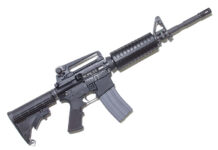
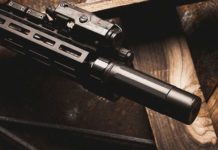
AR-15 piston systems do not make gas go away. They merely vent it in different locations. Here, the gas is venting directly behind the front sight, as it is meant to.
The big drawback to the Direct Impingement (DI) system is the gas blown back into the receiver. It does, however, have several manifest advantages, advantages you should not discard simply because all your buddies say you should.
First of all, it is light. All the system needs is a hollow tube leading from the gas port back to the receiver. Unless you make your AR-15 piston system out ofunobtainium, it isn’t going to be that light, not ever. When you are laden with a whole lot of gear, lighter becomes very attractive.
Also, the hollow tube does not press on or bind the barrel, and so the barrel is essentially free-floated. If you use a free-float hand guard, secured to the receiver at the barrel nut (and to the barrel not at all), the barrel is free-floated, and you can thus wring all the potential accuracy out of it that it has.
With a good barrel, an AR can be as accurate as a lovingly-blueprinted bolt gun.
The AR-15 piston system removes all those advantages. First, it adds weight. Granted, some systems not so much, but they all add something.
Second, part of the weight is a more secure (and often heavier) gizmo bolted on the barrel up front. That weight makes the barrel harmonics of firing a different thing than the DI system. You see, every time you fire, your barrel gets hit as if by hammer. It vibrates. Accuracy is the bullet leaving the muzzle at the same point in the barrel harmonics on each shot. If the barrel harmonics vary, so will accuracy.
The AR-15 piston system, working in or on the barrel block the new system requires, adds mass and potentially vibration, and also can potentially bind the barrel as the barrel heats. (Binding depends on how securely the AR-15 piston system is held by the barrel/receiver geometry.) A superb barrel will have few or no stress lines in it. A bad barrel can have many.
The stresses can be from the original steel bar, or be added in the machining or straightening process. As the barrel heats up, the stress lines “unkink” and the barrel points differently. It also changes the harmonics, and thus, potentially, accuracy. (A brief aside: hammer-forged barrels have the stress lines pounded out of them, and cryogenically-treated barrels have the stress lines relaxed.) If the AR-15 piston is a firmly-held object between block/barrel and receiver, it can lever the receiver as the barrel heats up and unkinks.
The extra AR-15 piston parts can hold heat. Also, as the barrel expands as it heats, the piston parts heat up at a different rate, and add another potential binding or pressing on the barrel.
The piston itself can also influence accuracy. When the M1 Garand was the king of the target range, everyone knew that if the op rod got bent, accuracy went all to hell. Bending op rods usually happened when someone used the wrong powder, one outside the burning rate range the Garand would accept, and the rod was over-worked. But once bent, it was “goodbye accuracy” and the situation could be restored only with a new, correctly-dimensioned op rod.
When the M14 became the target king, it did so only after armorers figured out that the barrel could not be free-floated and had to be pre-stressed. The USAMTU match specs call for welding the gas system and front plate together, and using that as a lever to pull the barrel down as it is locked in the stock. The barrel starts out pre-loaded downwards, dampening the harmonics. If the bedding goes, the pre-load changes, and accuracy goes kerflooey. However, no need to replace parts there. “Simply” re-bedding will do. However, every time the action was removed from the bedded stock, the bedding suffered a bit. Match shooters using the M14 became adept at cleaning their rifles without removing them from the stock.
The AR can be free-floated, even with a piston system, but the piston has to neutrally influence the barrel, or your accuracy, zero or both will change as the barrel heats up. With the DI system, not so much – nay, hardly at all, especially with a good barrel in it.
And, on top of all that, the AR-15 piston system brings with it another problem: tilt. (Actually, two, but I’ll detail that in a bit.) When the DI system pressurizes the carrier, it basically pushes the carrier rearward axially. That is, the direction and location of the thrust is on, and in line with, the center of the carrier itself. Enter the AR-15 piston system, which taps or pushes on the carrier up where the gas key used to be. The carrier tries to tilt in the upper and is restrained from doing so only by the buffer tube.
The buffer tube, being made of aluminum, is not at all happy with the steel carrier slamming down and gouging it. Now, the gouging isn’t all that bad, at least not what I’ve seen of it. And not all (even the early ones) AR-15 piston systems tilt or gouge. Me, if I really felt the need to use a piston system, and found that it gouged the buffer tube, I’d perform a simple calculation: will the buffer tube last as long as the barrel? If it did/would, I’d simply view the cost of a replacement buffer tube as part of the cost of a new barrel, and not sweat it.
If the tube wouldn’t, then a barrel replacement becomes a 2X or 3Xbuffer tube cost. At the moment, a plain old USGI-dimension, six-position carbine buffer tube costs $25. A good barrel (there isn’t much point in buying a cheap barrel) starts at about $200,and that is for a steel tube lacking sight, gas block (you’re going to take off the one for your AR-15 piston system, right?), nut and such.
So, as long as it doesn’t cause a functioning problem, replacing the buffer tube is a fraction of the total cost to replace as hot-out barrel.
Oh, and the second problem with an AR-15 piston system? Cost. If you use a replacement kit, you’ll be replacing the existing carrier with a piston-compatible carrier. If you buy a full-up rifle/carbine, you’ll be paying an extra for the design and fabrication costs of the new parts. Either way, your new piston-equipped rifle is going to cost a bit more than a plain old DI-running one.
Pages: 1 2
Related Posts:
About the Author: Patrick Sweeney is the author of many of Gun Digest books' best-selling titles, including Gun Digest Book of the 1911, Vols. I & II; Gun Digest Big Fat Book of the .45 ACP, Gun Digest Book of the AR-15, Gun Digest Book of the AK and SKS, Gun Digest Book of the Glock and Gunsmithing: Pistols and Revolvers, among other titles. A master gunsmith, Patrick is also Handguns Editor for Guns & Ammo magazine.


If memory serves, the only other production DI rifle was the French MAS of the 1940′s. The M16 happened twenty years later. I believe that was the only DI rifle Eugene Stoner designed (consider the AR10 family), and no one else has used the DI system since. Stoner went on to design the AR18 and Stoner 63, both piston systems. That said, you would think that if the DI system rifle was all that great, more gun designers would use it, but none did, not even Stoner. That is conclusive.
About accuracy, I have read much conjecture, speculation, and common knowledge, but I have not seen any hard data generated by the scientific method. If the piston system lacked in accuracy compared to the DI, I’d wager that if the pistons got as much attention, tweaking, and tuning as the DI originally did, either system could win it all on any given day, given the right shooter.
As for me, I started with a piston AR and never looked back. Cleaning time is better spent shooting, and I have no accuracy complaints.
I have personally used some very high grade AR15 guns in competition. I would never use this type of gas system for a serious survival rifle. Other military guns that use this system like the Rashid, Swedish Ljungman etc. all have the same problem, they jam up when not squeaky clean and drowning in lubricants period.
The AR15 was a failure in Vietnam and 40 some years later failed in Iraq as well. Remember the cute little blond who was the only soldier among her group that had an AR that kept on working? I might add even a fine mist of water like a light rain will mix with the burnt power and jam up these guns right quick. Its amazing the U.S. is still using such a worthless weapon in combat.
I think that the mass in motion in a piston design also need to be considered. Slow motion film of an AK being shot show lots of flex in the parts due in part to the large mass of the piston/bolt carrier assembly. I agree with your conclusion, and find the original design near perfect. All guns need cleaning, so that is never a reason to switch to a piston.