
Get Your FREE Download! Scope out the Best AR-15 Optics…
From AR-15 scopes with specialized reticles to fast-pointing red-dot scopes for AR-15s, there are literally hundreds of optics solutions with which to outfit your AR-15. Of all the AR parts and AR-15 accessories available for your rifle or carbine, the optics are arguably the most important. From competition to home defense, your ability to see the target and acquire it quickly and accurately will be determined by the type and quality of AR-15 scope or optic you choose. This download covers popular AR-15 optics like Aimpoint, Eotech and Leupold and many other types of AR-15 sights – plus tips on AR-15 scope bases and sighting in your AR-15. You’ll learn about:
• AR-15 Red-Dot Scopes
• AR-15 Long-Range Scopes
• Bullet Drop Compensators (BDC)
• Night Vision Scopes for AR-15
• How to ZERO Your AR
• and more!
Don’t buy an AR-15 scope until you get this FREE download!
AR-15 Optics
To receive your free download, join our mailing list and never miss news, tips, promotions or discounts.
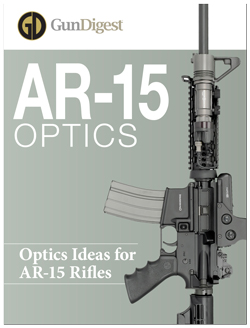
Here’s a Sneak Peek Inside Your Free AR-15 Rifle Guide:
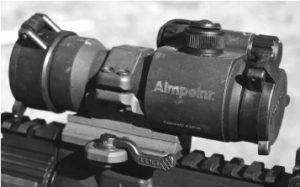
Aimpoint makes tough optics. They must; they’ve sold literal truckloads to DoD.
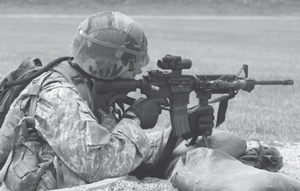
A non-magnifying optic is plenty good to 300 meters, as this NG trooper is demonstrating. However, it doesn’t help much in target ID.
Optics choices for the AR are pretty simple; after all, you’re just picking a scope for a rifle. You’d use the same criteria you’d use for any other rifle: expected ranges, anticipated target size, amount of light available, and durability desired.
Of course in the defensive, law enforcement or military context, durability becomes much more important than in hunting. If I’m spending an afternoon on a ridgeline over a prairie dog town and my scope breaks, I can get another out of the truck. (Rifle or scope, my choice.) Or come back another day. If the bad guys are shooting at me and my scope breaks, I might not have the option of going back to the truck. As for the option of coming back another day – well, things don’t work that way.
Scopes selected for military use tend to be heavier, bulkier and a lot more costly than what would be “good enough” for hunting. That’s why you see bullet-proof rings like LaRue and Badger Ordnance on military rifles, and honkin’ big scopes like Leupold or the European makers. A few ounces, or even a pound, of extra weight don’t matter in those circumstances.
Consider the situation of a squad designated marksman (or even a school-trained sniper) in a small group of SpecOps troopers, hiding on a ridgeline. Between the bunch of them, the government has spent a staggering amount of money: they all draw pay (not enough, in my opinion) and have since they enlisted. They’ve been fed, housed, clothed, and sent to an impressive number of schools. They’ve been through training exercises that cost bundles of money. Then, the government ships them and all their gear halfway around the world. Going over on a C-5A or a C-17 costs a lot more per-person than flying coach on a commercial airliner. Then, they took a helicopter ride. That chopper requires another group of people; pilots, maintenance techs, air traffic controllers, all of whom cost the government a lot of money.
Lying there in the dust, each one of those SpecOps troopers represents a million dollars or more of invested money.
Do you really think, once you start considering the costs, that the government really cares that another scope is “just as good” and costs “hundreds less”?
Claim Your FREE Download on AR-15 Scopes and Optics
Join the Gun Digest newsletter and become an AR-15 sights expert!