Probably no other area of firearms offers as much diversification as the muzzleloading field. On the one hand, we have the very primitive firearm, such as the matchlock; on the other, we have today’s sophisticated muzzleloaders that incorporate the very latest in modern materials and design.
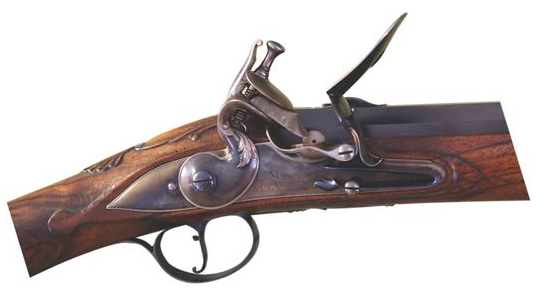 Both ends of the spectrum have their adherents and champions, and discussions go on and on about which is better or more “right.”
There are definitely more of the hunting-oriented shooters that embrace the latest in muzzleloading development, mostly due to the proliferation of special muzzleloading seasons in nearly all states. While the traditional sidehammer shooter is in the minority today, there are still large numbers of folks who want to “do it like our forefathers did.” Between custom gunsmiths and the muzzleloading industry, both groups are supplied with a wide variety of firearms and accessories that cater to whatever interest those hunters and shooters may have.
The Holy Grail for the traditional shooter is a custom hand-built gun by one of the top gunmakers. These guns are often works of art, and rank up there with fine paintings and sculpture. They quickly become heirlooms that are passed down in families from one generation to the next. While they are collectible art, they have the advantage of being completely useable and, in fact, are intended for use in the hunting field and on the target range. Guns by known makers appreciate in value, the same as paintings by known artists. Lucky is the fellow that gets a nice rifle made by a relatively unknown maker who later becomes a noted gunbuilder. His investment in the rifle will continue to grow as the reputation of the builder grows.
Mark Silver
One of the very best of the custom builders working today is Mark Silver, a Michigan gunmaker. Silver has been a full-time gunbuilder since 1976, is very well known and recognized as one of the premier builders working today. Early in his carrer, he worked as a journeyman for a couple of years with the late John Bivins. Bivins was considered by many to be the leading authority on early golden age rifle-building. Silver is a past president of both the Contemporary Longrifle Association and the American Custom Gunmakers Guild, which shows the regard that other custom gunmakers have for him. He regularly teaches courses related to gun-building at the gunmakers’ seminars sponsored each year at Western Kentucky University by the National Muzzle Loading Rifle Association.
Silver will build most any style gun that the customer wants, but specializes in the Kentucky rifle of the Golden Age, as well as fine Continental rifles and fowlers. He builds guns using the same hand tools that the gunsmiths of the 1700s used: hand saws, planes, chisels, gouges and scrapers. The finishes he uses are the traditional nitric acid stains, spirit varnishes, oils and waxes that were available to the 18th century gunsmith.
The first rifle we’ll look at is an American flintlock long rifle done in the style of the Moravian gunmakers of Christians Spring, Pennsylvania and Bethabara (now Salem), North Carolina during the 1770-80 period. The 54-caliber rifle has a 44-inch barrel and weighs in at 9 pounds. The curly maple stock is stained with nitric acid stain and finished with a red-tinted varnish. The gun is brass-mounted with hand-wrought buttplate, sideplate, ramrod pipes and forend tip. The barrel is blued to duplicate the charcoal bluing that was common on these rifles. The finely tuned flintlock is custom shaped and detailed, engraved in the Moravian style and finished with color case-hardening that is worn to enhance the relief borders and engraving. The attention to detail is fantastic, making this a serious work of art.
The second gun we’ll examine is a rifle of the type that would have been made by top London gunsmiths in the 1735-55 period. This 7-pound rifle has a 28-inch 54-caliber rifled barrel and is, of course, a flintlock. The gun is steel-mounted and charcoal blued with hand-chiseled relief sideplate and hammer. There is a relief border on the lockplate with the color case-hardening selectively removed to highlight the relief work. The lock features a hand-pierced pan, 24k gold-lined, typical on finer English rifles of the period. The rifle is stocked in figured English walnut, and is carved with a shell behind the barrel tang and scrolls along the wrist. The fore-stock has a relief molding along the ramrod channel that transitions into simple relief and incised decoration behind the rear ramrod pipe. Overall, a typical high-quality rifle that would have been made by a London gunmaker for landed aristocracy.
David L. Dodds
Another custom maker who does fine work is David L. Dodds, a full-time gunmaker who has been building since 1969. He says he got his start and early training by studying a series of articles on gunbuilding written by John Bivins for Rifle magazine. He was also helped with advice from close neighbor and well-known gunmaker Ron Ehlert, and another master craftsman, Jim Chambers. The above, combined with a great deal of natural talent, put him on the road to becoming a fine gunbuilder.
Dodds’ major interest lies in duplicating original guns. This is a difficult task as we all tend to bring some of our own personality into whatever we are doing. Duplicating an original firearm in the style of the original gunmaker is much akin to copying someone’s handwriting – some folks can do it well, but they are rare. Dodds appears to be one of those rare individuals as well as being a fine gunmaker in his own right. Presently, he is interested in the Reading school of design. These guns tend to be rather plain, with little or no carving and engraving, but they show an eye-pleasing architectural line that is very functional. Ordering a rifle from any of the better gunmakers is akin to having a tailored suit of clothes made. Measurements are taken so the finished gun will fit your physical build. You can specify style, type of wood (within limits – it has to match the gun you are ordering), barrel, caliber, lock and a myriad of other details. Be prepared for a long wait as most of these folks are several months behind on orders. You get in line and wait your turn. The wait is very much worth it, however.
Taylor’s & Company
Taylor’s & Company is well known for supplying high-quality reproductions of early firearms, both muzzleloading and cartridge models, to traditional shooters that have interests in the various eras of blackpowder use from the pre-Revolutionary War period through the Civil War, and on into the taming of the American West. They have a new rifle that will tempt those with an interest in early exploration of the West, as well as those who just like large-caliber rifles.
The new rifle is a faithful copy of a Short Model 1842 rifle musket that was made up especially for the Fremont Expedition in 1847 at the Springfield Armory. These rifles were the same pattern as the regulation 1842 with the exception of being shortened to 48? inches overall.
The 69-caliber rifled barrel is 33 inches long with a bayonet lug at the muzzle. An elevating rear sight is combined with a blade front, per the 1842 Model. All furniture is iron and the gun has sling swivels of standard loop size for military rifles and muskets of the time. The stock is walnut with an oil-type finish. A steel ramrod with a trumpet-shaped end is supplied and is held in place under the barrel with a spoon-type spring located in the bottom part of the ramrod channel in the stock.
The percussion lock is marked with the typical eagle head and the date 1847. The nipple takes Musket caps. The rear sling swivel is attached to the iron trigger guard.
This rifle is a very nice copy of the Fremont gun, with excellent fit and finish. The 69-caliber bore should handle either the patched roundball or the hollow-base Minie very well. I look forward to getting one of these military big bores in my hands for a shooting session.
Thompson/Center
Thompson/Center is a name well known to muzzleloaders for their line of both muzzleloading and cartridge firearms. They were one of the very first to put a mass-produced muzzleloader on the market many years ago and they continue to expand and improve their frontstuffer line to this day.
The newest addition is called the Triumph. This is a 50-caliber break-open type of modern muzzleloader. The T/C folks have added some really innovative design components that make this top-break stand out of the crowd. The gun shows a streamlined shape with a center-hung visible hammer and only 4 moving parts, including the locking system for the tip-up barrel. The hammer is a rebounding type that locks in a safety position so that an accidental blow to the hammer will not fire the rifle; the trigger must be pulled for the hammer to contact the firing mechanism. The trigger pull is crisp and factory set at 3 to 3? pounds, just about right for hunting or target shooting. The composite stock is capped with a SIMS Limbsaver recoil pad that effectively cuts felt recoil approximaely 25 percent. A solid aluminum ramrod is supplied and the barrel is available in either the standard blue, or with the Weather Shield finish in either black or stainless. The Weather Shield finish is an advanced metal coating that protects the metal and wears very well, being much tougher than standard bluing.
The most unique design feature of the Triumph, however, is the new Speed Breech. This #209 primer breech plug can be removed by hand for greater ease of cleaning, or for clearing a loading mistake in the field, by rotating it 90 degrees and pulling it out of the barrel; potentially a real hunt-saving feature.
There are three gas-seal rings on the front of the breech plug to stop gasses from coming back into the threads of the plug, or into the action itself. These are very similar to the piston rings in the cylinders of your car. The interrupted thread on the breech that allows easy removal is very similar to that used on the breeches of large cannon for many years, so strength is certainly not a concern. The breech plug is knurled at the rear for easy grasping during removal. There’s really nothing new here; several good designs were brought together to create this innovative breech plug.
This type of breech plug is also available on the Encore series of guns. This breech is partnered with a #209 extractor that rotates to the side with finger pressure to allow the Speed Breech to be easily removed. This eliminates the need to remove the extractor before breech plug removal as was necessary in the past. These T/C innovations will make the care and feeding of their muzzleloaders easier.
Knight Rifles
Another name that is associated with firsts in the muzzleloading field is Knight Rifles. The MK85 Knight rifle was the first really practical and widely distributed rifle featuring the now-familiar inline design. It seems that every year this company comes out with something new and different, often leading the pack with innovative products. Their newest offering is new thinking on a familiar style – the top-break type of muzzleloader.
Called the KPI, this rifle seems a typical center-hung, exposed hammer top-break design but it is engineered to be taken down to its component parts in less than 30 seconds – without tools. The forearm is removed by pulling down on a lever, the action is opened by the push of a button, the hinge pin is removed, which releases the barrel from the receiver, and the trigger group, with the hammer attached, is removed from the receiver by pushing a small lever in front of the trigger. It takes less time to do it than to tell about it. The ease of removing the barrel is important for another reason besides ease of cleaning, but more on that later.
The gun is available in blue or stainless with a composite stock in either black or camo. High-visibility sights are standard and the barrel is drilled and tapped for scope mounting. What makes this rifle unique, besides the quick take-down, is that extra barrels can be interchanged in the following chamberings: (centerfire) 223, 243, 270, 30/06 and 300 Win. Mag.; (rimfire) 17 HMR and 22 LR, as well as the 50-caliber muzzle-loading barrel. This makes the KPI about as close to an all-around gun as one can get. The multicaliber range of barrels available will allow hunting a wide variety of game over various seasons. The change from centerfire to rimfire is easily accomplished with a screwdriver and Allen wrench. With an overall length of 39? inches (centerfire/rimfire) and 43? inches in the muzzleloader configuration and a weight of around 8 pounds, this is a trim and versatile little rifle.
Traditions Performance Firearms
Traditions has added a recoil-reducing system to their Pursuit XLT Extreme. The system, which utilizes a cam, roller and spring contained in the buttstock, is reportedly reduces felt recoil by 75 percent – a very significant amount. Given hunters’ proclivity for the heavy magnum charges these days, this is good news for those of us who are recoil-sensitive.
Ballard Rifle and Cartridge Co.
Ballard, based in Cody, Wyoming, has recently undergone a change of ownership and reorganization. The company is expanding the line of fine blackpowder cartridge rifles that they are known for. They, of course, build a beautiful reproduction of the venerable Ballard rifle. They are also doing a very nice copy of the Winchester High Wall and Low Wall rifles in various calibers. With high grade walnut and literally breath taking authentic bone and charcoal color case-hardening, all three models are fine examples of the gunmaker’s art. Dimensions are exactly the same as the original guns. In fact, part of the Ballard business is doing restorations of original guns. Their parts will interchange with originals and a “clunker” can be brought back to “as new” in the Ballard shop.
The Ballard model rifles are being seen more and more on the firing lines at various black powder cartridge silhouette competitions, including the Nationals at Raton, NM as well as Schuetzen competitions throughout the country. The Ballard action is a popular basis for fine target rifles. The record for blackpowder and lead bullets was fired in 1902 from a Ballard rifle, a 10-round group measuring 0.722-inch at 200 yards. That record still stands.
Ballard rifles can be had in most of the blackpowder-era cartridges, as well as appropriate modern smokeless calibers. Their target chamberings are done on a custom basis to extremely close tolerances; so close, in fact, that chambers are cut to match the make of brass used. No wonder the darn things shoot!
The High Wall action is well-liked by blackpowder cartridge shooters in the silhouette game and there is a high percentage of this action type seen on those firing lines. and often in the winners’ circle. The very strong High Wall action lends itself not only to most any blackpowder cartridge, but it can also be chambered for some modern cartridges in the magnum family.
Ballard’s attention to quality and range of models make these guns popular with shooters of all interests, be it target shooting with blackpowder cartridges or hunting with the latest smokeless calibers. One would be hard-pressed to find better quality reproduction rifles from the late blackpowder era.
Millennium Designed Muzzleloaders
From the time of the earliest muzzleloaders, packaged loads have been used. The military, especially, used various “cartridges” to enclose powder and projectile in one package that was easy and quick for the soldier to handle when reloading. Most of these were paper type cartridges that the soldier tore open with his teeth, then dumped the powder down the muzzle, followed by the bullet and, usually, the paper that wrapped the unit.
The latest upgrade of the packaged reload is one from Millennium Designed Muzzleloaders. MDM has teamed up with Magkor, the producer of Black Mag 3, a blackpowder substitute, to produce the “ThunderCharge,” a consumable cartridge for muzzleloaders. Using MDM’s Dyno-Core bullets of from 225 to 325 grains, the optimum charge of Black Mag 3 is compressed and attached to the bullet base. To load, the complete package is pushed down the barrel at one time, eliminating the need to handle the bullet and powder separately. As stated, the powder charge is matched to each bullet weight to deliver not only the best accuracy, but the best terminal ballistics as well.
Presently available only in .50 caliber, the consumable cartridges will come in packages of either 6 or 8. Next thing you know, someone will figure out how to wrap the whole thing in a brass case with the primer attached.
Connecticut Valley Arms
Along with self-contained cartridges, a new ignition system is coming to muzzleloading. Connecticut Valley Arms (CVA) is introducing a muzzleloading rifle with electronic ignition. Due to be on dealers’ shelves by mid-year, the Electra looks like a typical inline rifle, but with a projection in front of the trigger guard that resembles the magazine of a cartridge rifle. The projection contains the electronics that fire the rifle.
A thumb-operated safety disconnects the system for safe carry or loading. A pull of the trigger initiates an arc in the breech plug that ignites the powder charge. There is no primer explosion and no displacement of the powder charge from the force of a primer ignition. Trigger pull is very smooth with no release felt – the trigger is merely a switch that activates the electric arc in the breech plug. The system is supplied with a standard 9-volt battery that will fire the rifle at least 500 times and will last around 600 hours if left turned on.

Next Step: Get your FREE Printable Target Pack
Enhance your shooting precision with our 62 MOA Targets, perfect for rifles and handguns. Crafted in collaboration with Storm Tactical for accuracy and versatility.
Subscribe to the Gun Digest email newsletter and get your downloadable target pack sent straight to your inbox. Stay updated with the latest firearms info in the industry.