
They wrote legislation that established the Corporation for the Promotion of Rifle Practice and Firearms Safety. This non-profit federally chartered corporation was given the responsibility for the supervision, oversight, and control of the U.S. Civilian Marksmanship Program. The law forming this corporation mandates that the mission of the CMP is the “Instruction of the citizens of the United States in marksmanship&.” with the highest priority going to training juniors. The CMP supplies firearms safety and marksmanship training through a nationwide network of affiliated shooting clubs, state shooting associations, and other organizations such as the Boy Scouts and school shooting teams.
The official United States government-sponsored Civilian Marksmanship Program (CMP) is known to only a small fraction of American gun owners, even though it is of incredibly high importance to our country and the future of firearms use in general — for ourselves and our descendants.
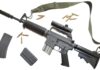
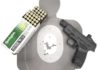
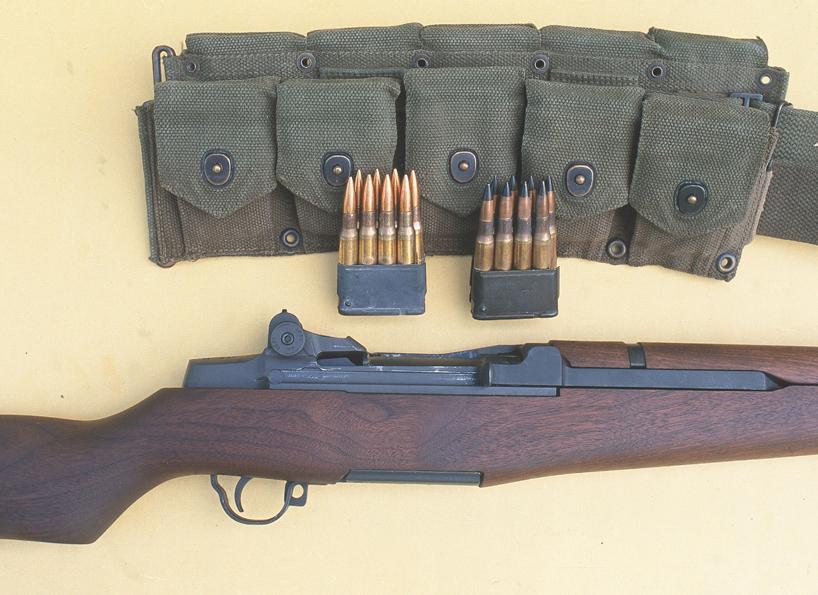 Author’s service-grade M-1, shown here with a WWII ammo belt, a clip of ball ammo and a clip of black-tipped armor piercing (AP) ammo. |
My family has a long history with the Civilian Marksmanship Program, going back over 70 years. Indeed, I personally owe a great deal of who and what I am to my participation in various CMP programs since I was a young lad. I still own an M1917 30-06 rifle and a Colt M-1917 45 ACP revolver that my late father purchased in the early 1930s from the CMP’s predecessor — the Director of Civilian Marksmanship (DCM).
Did you know that gun clubs affiliated with the CMP can qualify to do the same at even better prices, and get substantial other support from the CMP? Even better, the proceeds of the sale of all these items goes to fund the operation of the CMP and its many programs.
For the last 100 years the Civilian Marksmanship Program has trained millions of American youths and adults to shoot in a safe and proper manner. In addition, the CMP sustains the operation of the U.S. National Rifle and Pistol Matches, supports the marksmanship programs of all the state shooting associations, and has made sure that our country always has a substantial number of our population who know how to shoot well. My own extensive experience in the military bears out the significance and importance of my personal CMP background and training.
The CMP program can trace its roots clear back to 1903, when Congress first passed legislation to establish the formation of the National Board for the Promotion of Rifle Practice (NBPRP). This legislation was passed with the full support of President Theodore Roosevelt and the National Rifle Association (NRA). At the same time it also established the U.S. National Rifle and Pistol Matches, as well as appropriations to transport teams of marksmen from the various branches of the U.S. military to attend the National Matches. The main objective of these laws was to promote better rifle marksmanship in our armed forces.
In 1905 Congress passed further legislation, again with the strong support of President Roosevelt and the NRA, that authorized the sale (at cost) of surplus military rifles, ammunition, and other military equipment to civilian shooting clubs meeting requirements laid down by the NBPRP. This was the beginning of a century-old U.S. government-sponsored national program that continues to this day to supply obsolete military rifles to qualified civilians for the purpose of promoting and developing marksmanship in the civilian population. Right from the beginning, the primary objective has been to build and maintain a reserve of trained marksmen among the civilian population that could be called upon for military service in time of war, either as soldiers or marksmanship instructors.
In the summer of 1916, with Europe already at war, Congress passed the National Defense Act. That law earmarked money specifically to promote civilian marksmanship training and authorized the distribution of appropriate arms and ammunition to organized civilian shooting clubs for the same purpose. In addition, it set aside funding for the operation of military rifle ranges and the transportation of military shooting instructors to assist civilian clubs in marksmanship training and allowed civilian shooters access to most military rifle ranges. In addition, it created the office of the Director of Civilian Marksmanship (DCM) to oversee these activities. Finally, it authorized funds to transport civilian teams from across the country to the National Matches to compete with the standard military rifles and pistols of the day. Much to the embarrassment of the military teams, in 1916, in the first of the National Matches open to civilians, both the individual national service rifle and pistol champions were civilians.
The aftermath of World War I found the U.S. military awash with a huge surplus of military rifles and handguns. These included 280,000 Russian M91 7.625x4Rmm Mosin-Nagant rifles originally made by Remington and New England Westinghouse for the Russian government. These had been rendered undeliverable by the Russian revolution so the U.S. government purchased them from their manufacturers, ostensibly for training purposes, but more likely to help the manufacturers out of a financial bind since they were already doing substantial work on other important U.S. government contracts. I cannot find any record that the M91 Mosins were ever actually used for training purposes. However, some of these M91 Mosin rifles were issued to — and carried by — U.S. troops assigned to the international expeditions to Russia to protect Allied interests from the Bolshevik revolution, during and shortly after WWI.
Also on hand were 20,000 Canadian Ross Mark II 303 straight-pull rifles procured from Canada during WWI, ostensibly for use as training rifles. In addition, there were over 100,000 obsolete U.S. Krag 30-40 rifles and carbines, thousands of old 45-70 Springfield “Trapdoor” carbines and rifles, over 200,000 M-1917 S&W and Colt 45 ACP revolvers, and a couple million M-1917 “Enfield” 30-06 rifles. There were also large quantities of M-1903 30-06 rifles and M-1911 45 ACP pistols that were, during the post WWI period, the standard service arms of the U.S. armed services.
For more information about the Civilian Marksmanship Program (CMP), Click Here
 If you like this article, you’ll love the book it appeared in — Gun Digest 2008.
Great words from a truly great patriot and American! I grew up with “Chuck” in the 1950’s and only parted with him when my family moved away. My fondest memories are of all the firearm and gun stuff Chuck shared with us all. His Dad was a chemist and it rubbed off on Chuck: we’d take our Boy Scout knives to grade school, scrape the plaster walls in the gym for “niter,” use match heads for sulphur and beat up charcoal briquettes to make crude black powder! We were grade school kids! Later in life I would meet up with Chuck at regional and state wrestling matches–he usually won! I sure do miss him. Bet he’s showing St. Peter DCM skills in heaven! We love you, Brother!