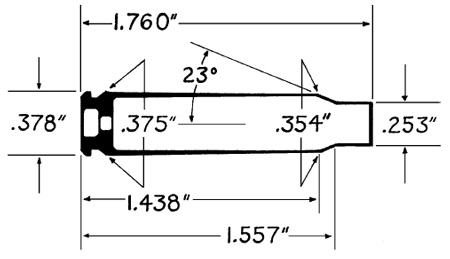
Historical Notes
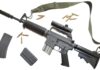
The 223 Remington first appeared in 1957 as an experimental military cartridge for the Armalite AR-15 assault rile. In 1964, it was officially adopted by the U.S. Army as the 5.56mmBall cartridge M193. It is used in the selective-fire M16 rile which is based on the original AR-15 design. The cartridge was the work of Robert Hutton, who was technical editor of Guns & Ammo magazine and had a rifle range in Topanga Canyon, California.
One of the requirements for the cartridge was that the projectile have are tainted velocity in excess of the speed of sound (about 1,080 fps atsea level) at 500 yards, something you could not achieve with the 222 Remington. Working with Gene Stoner of Armalite, Bob Hutton designed a case slightly longer than the 222 and had Sierra make a 55-grain boat tail bullet. This combination met the design requirements. All this was documented in the 1971 issue of the Guns & Ammo Annual. Originally an alternative military cartridge, the 223 (5.56x45mm) is now the official U.S. and NATO military round.
We should note here that NATO forces, including theUnited States, have standardized a new 5.56x45mm round with aheavy bullet and the M193 is no longer standard. Shortly after the military adopted this cartridge, Remington brought out the sporting version, which has largely replaced both the 222 Remington and Remington Magnum in popularity. Practically every manufacturer of bolt-action rifles has at least one model chambered for the 223. In addition, there are a large number of military-type semi-auto rifles available in this caliber. At one time, the Remington Model 760 pump-action was available in 223.
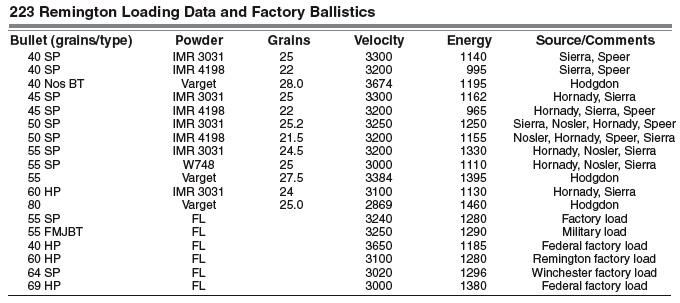 General Comments
The 223 Remington is nearly identical to the 222 Remington Magnum, the only difference being that the 223 has a slightly shorter case. The two are not interchangeable, although the 223 will chamber in a 222 Magnum rifle. The result, though, is to create a gross headspace condition, and the 223 case can rupture if fired in the 222 Magnum chamber.
The 223 has proven to be an effective military cartridge for fighting in jungle or forested areas and for close-in fire support, and has been improved lately by NATO with heavier (SS109 designed by FN of Belgium) bullets fired through fast-twist (1 in 7-inch) barrels. As a sporting round, it is just as accurate as any of the other long-range, centerfire 22s. Military brass cases are sometimes heavier than commercial cases, so maximum loads should be reduced by at least 10 percent and approached cautiously. That is because the reduced case capacity results in a higher loading density and increased pressure with the same powder charge. The 223 Remington can be classed as an excellent medium-range varmint cartridge at ranges out to 250 yards.
In 1979, SAAMI cautioned shooters that 5.56x45mm military chambers and throats differ from 223 Remington sporting rifle chambers. Therefore military ball ammo may produce high chamber pressures in sporting rifles.

Next Step: Get your FREE Printable Target Pack
Enhance your shooting precision with our 62 MOA Targets, perfect for rifles and handguns. Crafted in collaboration with Storm Tactical for accuracy and versatility.
Subscribe to the Gun Digest email newsletter and get your downloadable target pack sent straight to your inbox. Stay updated with the latest firearms info in the industry.