Better hunting optics deliver more detail, brighter images, clearer aim and less eye-strain during long glassing sessions. Here’s a look at some of the best scopes and binoculars.
The best optics available now would have astonished shooters who came of age in my youth. And while prices have climbed substantially, you don’t have to pay top dollar for glass that to the unpracticed eye seems as good as any on the market. Weaver’s K4, the standard by which rifle-scopes were judged half a century ago, is no longer made in the U.S. It doesn’t look like an original K4 or sell as cheaply. But it is still, in my view, a terrific buy. It is much better, optically, than the original. And it costs less, relative to the competition, than it did when I shot a deer with one in 1968.
Back then, hunters didn’t use laser rangefinders or illuminated reticles. They were delighted by constantly centered crosswires and nitrogen-filled tubes that didn’t fog. If the adjustments worked and the occasional bump didn’t affect zero, if the field and eye relief allowed for quick aim, riflemen rejoiced.
Ensuing years have brought many incremental improvements, a few which qualify as pivotal. What you consider important in a sight or a binocular depends in part on what kind of hunting you do – also on your age and personal tastes. Some shooters dote on sophistication and new features; others prefer Spartan optics with traditional lines and no more complexity than necessary.
Whatever your bent, there’s plenty of interesting glass to look at. And through.
Aimpoint
A sight is useless if it isn’t easy to use. While rifle-scopes have become bigger, heavier and more powerful, and are now bedecked with rangefinding reticles, resettable BDC dials, parallax adjustments and scales bearing ballistic information, shooters do have an alternative.
In 1975 Swedish inventor Gunnar Sandberg came up with what he called a single-point sight. You looked into a short tube with one eye and saw a dot superimposed on the target with the other. You couldn’t look through this sight at all! But shortly Sandberg developed more advanced devices, and now, 30 years later, his Aimpoint company has become a world leader in the broad field of “red dot” sights.
On a moose hunt not long ago, an Aimpoint Model 7000, mounted on a Blaser rifle, not only gave me fast aim in dark, thick cover; it helped me shoot 1-inch groups at the range. The company’s Kenneth Mardklint explained to me that an Aimpoint’s front lens is a compound glass that corrects for parallax. An ordinary single lens up front still reflects the dot produced by the diode in the rear bottom of the tube. But Aimpoint’s front “doublet” brings the dot to your eye in a line parallel with the sight’s optical axis.
The reflective path of a single-lens sight varies with eye position. If the dot isn’t centered in the sight, you get parallax error at distances other than the one for which the sight was set. With an Aimpoint, you hit where you see the dot, even when your head position puts it off-center in the field. To ensure fine accuracy, turn the brightness dial down to the lowest practical setting. In dim light, you need very little illumination to see the dot quickly; in bright daylight, you’ll need more.
Aimpoint sights with no magnification boast unlimited eye relief, so there’s no time lost in finding a full field of view. You can point with both eyes open as with a shotgun. Models with magnification have generous eye relief. The 2007 Aimpoints feature ACET. Advanced Circuit Efficiency Technology reduces power demand, boosting battery life on the new Aimpoint 9000s to 50,000 hours with the brightness set on 7 (the highest setting is 10). The 9000 series comprises several models, including compact Comp versions that weigh as little as 6.5 ounces. You get a choice of 2-minute or 4-minute dot (1- or 2-minute with the 2x converter). Adjustments are positive, each click moving point of impact 13mm at 100 meters.
Aimpoint supplies military sights to U.S. and French armies, and hunting models in 40 countries. Last May, the company signed a contract for 163,000 rifle sights for the U.S. military establishment. One of every 10 Swedish hunters using optical sights favors Aimpoint. See the complete line at aimpoint.com.
Alpen
A decade ago, Alpen Optics shouldered its way into a market already crowded with imported East Asian products. The company has steadily gained credibility with mid-priced rifle-scopes, binoculars and spotting scopes that deliver great value.
Alpen’s 2007 offerings include a dozen rifle-scopes. The lightweight 4×32 and a 3-9×32 Kodiak perform better than their prices suggest. The superior Apex line has fully multi-coated lenses; it comprises a 3-9×42, a 3.5-10×50 and two sights with adjustable objectives: a 4-16×50 and a 6-24×50. Eight models in the Kodiak line, from 4×32 to 6-24×50, offer bright, sharp target images at modest cost. They complement a series of affordable spotting scopes (a 20-60×80 sells for less than $400!). Alpen’s 12-36×50 Compact spotting scope, announced a few months ago, weighs just 20 ounces. There’s also a 15-30×50, an 18x36x60 and a 15-45×60. Get all the details at alpenoutdoor.com.
Brunton
A 32-ounce, waterproof 8-15×35 Brunton Zoom binocular garnered a “Gear of the Year” award from Outside magazine in 2006. Its roof prism design, magnesium alloy frame and lockable twist-out eyecups appeared first in Brunton’s top-of-the-line Epoch 10×42. The Brunton Zoom’s 273-foot field of view at 8x helps you spot game quickly. Crank it to 15x, and you have a spotting scope. Priced at $1,899, the Brunton Zoom complements a line of binoculars that includes three 43mm Epochs, in 7.5x, 8.5x and 10.5x magnification. An available doubler boosts magnification. The Eterna and Echo lines are less costly but deliver fine images. So to the Eterna spotting scopes: a 24-ounce Eterna Compact 18-38×50 and a full-size 20-60×80. Both feature fully multi-coated lenses with ED (extra-low dispersion) fluorite glass. Just 8 inches long, the Compact lists for $599 and should appeal to the hunter with long miles to hike. Even easier to pack is the new (for 2007) Echo Compact spotting scope, a 1236×50 that weighs only 21 ounces.
Brunton’s optics line includes rifle-scopes wearing the licensed NRA label. Fixed-power 4×32 and 6×42 hunting scopes sell for $109 and $119. A 6-24×50 target scope with adjustable objective lists for just $149 – a bargain, given its fully multi-coated optics, one-piece tube and mil-dot reticle. Affordability is the hallmark of NRA hunting variables too, with the 1.5-6×40 and 3.5-9×40 retailing for only $99. There’s a new “fast focus” series, with eyepieces on helical threads. Four variables, from 1.5-5x to 3.5-10x, cost from $129 to $169. There’s also a fast-focus 624×50 at $199. You’ll find binoculars and spotting scopes under the NRA banner as well. Find out more at brunton.com and nrasportsoptics.com.
Burris
“There’s not a lot new at Burris,” said Pat Beckett at the 2007 SHOT Show. Patrick is among my favorite people, partly because he tells the story straight. “But,” he added, “that’s because we have to catch up with orders for all the new products from last year and before! Besides, we’ve extended our scope lines to the point that we’re looking hard to find slots we haven’t filled!”
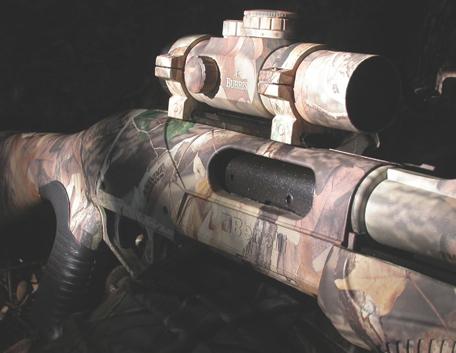
It’s all true. The company’s Short Mag scopes – 1x, 4x, 2-7x, 3-9x and 4.5-14x – made headlines in 2006. Short-coupled, with 3x- to 5-inch eye relief and resettable adjustment dials, they list for $316 to $581. Burris Signature Select scopes are an upgrade from the flagship Signature line, with more convenient turret location, index-matched lenses, rubber grips on power and AO rings. LRS versions (1.5-6x, 3-10x and 416x) offer resettable windage and elevation dials and lighted reticles. Both Short Mag and Signature Select scopes have 1-inch tubes, as does the fine 2-7×35 Full field II sight for shotguns and muzzleloading rifles. If you’re a handgunner, consider the Burris 2-7×32 EER scope with illuminated reticle.
Like other manufacturers, Burris is turning out more tactical scopes, for those who need them and those who pretend they do. The XTR (Xtreme Tactical Rifle) variables come in 1.5-6x, 10x, 3-12x and now 6-24x configurations. Their 30mm tubes have side-mounted parallax dials, steel-on-steel adjustments and illuminated reticles. The Fullfield II stable also has a tactical corner now, with a 3-9×40, a 4.5-14×42 and a 6.5-20×50. All have TAC-2 adjustments and AO collars up front. Burris tactical accoutrements include the SpeedDot sight and Laser flashlight that fit on Picatinny rails.
In 2006 Burris started shipping the LaserScope, a sight with a laser-rangefinding unit built in. It’s a 26-ounce 4-12×42 with ranging capabilities to 800 yards on reflective targets. I’ve shot with it and think it will appeal to some riflemen. More to my liking were Burris’ three new 30mm Euro Diamond scopes with a 3P#4 E-Dot reticle. The 1-4×24, 2.5-10×50 and 3-12×56 feature eight light settings on a turret-mounted dial. For more information on 2007 products, key up burrisoptics.com.
Bushnell
Bushnell could make money selling its catalogs by the pound. The 2007 book is chock full of useful glass for hunters. Some of it is new. Bushnell’s top-end Elite binocular series comprises four models: 10×50 and 12×50, 8×43 and 10×43. All accept Bushnell’s 2.5x doubler. A new Elite e2 binocular (8×42 and 10×42) also has the magnesium frame and XTR lenses of the Elite, but at less than $650 costs about half as much. The 8x5x45 and 10.5×45 Infinity binoculars also debut this year. Like the costlier Elites and less expensive Legend binoculars, they feature Rainguard lens coatings to shed rain.
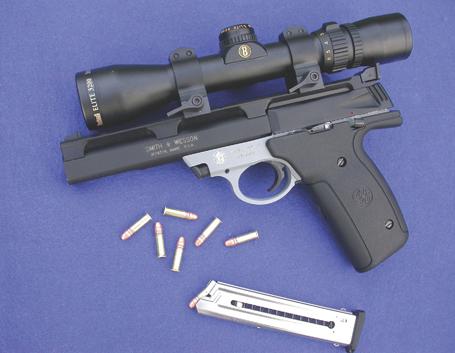
Bushnell’s long list of rifle-scopes has few new entries. A 30mm 624×50 in the Elite 4200 line and a 5-15×40 Tactical 3200 expand the top-end offerings. There’s also a 3-10×50 in the 3200 stable, and a 39×50 with illuminated reticle in the affordable Sportsman group. The biggest news for shooters is still the 4-12×42 rifle-scope with a built-in laser rangefinder. Announced last year, this 24-ounce sight delivers accurate range figures with the touch of a button out to over 500 yards. You get up to 8,000 ranges on its single 3-volt lithium battery, partly because the switch is programmed to shut down automatically after 30 seconds of non-use. This scope comes with a mil dot reticle and five dials to match the arc of your specific bullet and eliminate the need for holdover. The Yardage Pro laser range-finding scope has a magnesium body and lists for about $900.
For quick shooting up close, consider smaller options like the Trophy MP 1×32 red dot sight and Bushnell’s latest HoloSight. The MP boasts unlimited eye relief, an integral Weaver-style mount, quarter-minute clicks. It sells for $229. The new HoloSight now uses AAA batteries. Lighter in weight and lower in profile than previous models, it costs $300 less!
There’s little new in Bushnell’s rangefinder line for 2007 – though the company still leads the industry in this field, both in numbers sold and models available. It now has an Elite 1500 with an “ARC” feature, which compensates for vertical angle. So you’ll know not only actual distance, but the effective shot distance. If you shoot horizontally at a target 300 yards away, the actual and effective ranges are the same. But if the target is 300 yards away at a 45-degree vertical angle, the rifle will have to be aimed at a different place. Gravity affects only the horizontal component of the bullet’s flight, which is shorter than 300 yards. Bushnell’s Elite 1500 has an effective range of up to 1,600 yards on reflective targets, over 500 yards for big game animals. It features 7x magnification and a 26mm objective, lists for $499.

Bushnell’s spotting scope line is essentially unchanged. The Image View 15-45×50 announced last year still qualifies as news, though. It features a digital camera with VGA resolution and 16 MB of internal memory. It comes with a shutter cable and tripod, a hard case and PhotoSuite software, and a modest $240 price tag. For a long evening’s read on other Bushnell items, get a 2007 catalog or key up bushnell.com.
Elcan
Elcan is an acronym, from Ernst Leitz, Canada – the Leitz optical firm dating to 1849 in Germany. Elcan is also a subsidiary of Raytheon, one of those hulking companies with tall buildings but no human face, whose offices control the production of obscure hardware in far-flung factories with no signs on them. It’s the kind of company favored by middle-age Republicans, a firm with substantial military contracts and executives in foreign countries.
But Raytheon is also a down-home company, with an office in Richardson, Texas. Rusty Maulden works there. I met him last year at the SHOT show, where he tried to explain the Elcan scope. While Elcan has been building infrared scopes for U.S. military units since the 1980s, it is just now tapping the civilian market with what it calls the DigitalHunter. The Elcan scope is just a year old at this writing, and already its price has been trimmed by roughly 25 percent, to less than $1,200 for 2007.
The price reflects a sophistication you won’t see in ordinary optical sights. DigitalHunter shares a couple of features with most rifle-scopes: a stout alloy tube and multi-coated optics fore and aft. It mounts on a Picatinny rail or Weaver bases (you can’t use rings because the body is not round). A magnification range of 2.5x to 13.5x is broader than normal, and you change power with a button, not a ring. There’s no turret. A flat panel studded with buttons sits where you’d expect to find an elevation dial. That panel serves as a control center.
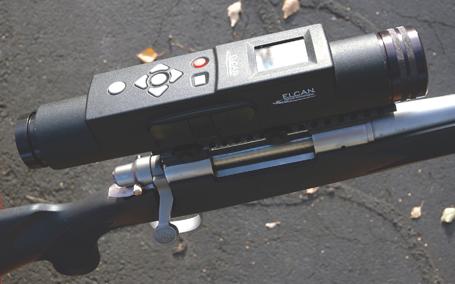
One of DigitalHunter’s most intriguing features is its ability to record up to five seconds of video during a shooting sequence. So you can see the immediate result of your bullet strike – or why you missed! The scope operates as a still camera too. A port allows you to attach a remote screen. If you’re spotting for a hunter or coaching a shooter, you see exactly what he or she sees in the sight picture. Or you can switch on the video and get up to seven five-second clips on a standard 64-mb SD card. A small monitor atop the eyepiece shows you the images after you record them.
“Before zeroing,” said Rusty, “you install software – ballistic data specific to your load. For each shot, then, you need only key in the range on the control panel and hold center. The scope self-adjusts for bullet drop.” I tested the scope’s compensating capability with a 30-06 to ranges beyond 400 yards. Groups were perfectly centered. No holdover. Because the target image and reticle share a common plane, there’s no parallax at any range.
I didn’t destroy one to test DigitalHunter’s durability, but Rusty assures me it will take as much of a bruising as most scopes. In Elcan’s trials, it has survived the repeated recoil of a 375 H&H.
Rusty told me that many people have asked for an integral laser range-finder – a device that would seem particularly suited to this scope. “We certainly have the means to engineer it into DigitalHunter. But a rangefinder would add weight and cost. Maybe later.” I’ll bet Elcan adds a rangefinder option soon.
Elcan’s new sight is certainly unconventional. At 28 ounces, it’s heavier than most scopes. And at dawn and dusk you’ll wish for brighter images. But DigitalHunter does allow you to photograph and video during or absent a shot. It’s a marvelous instrument, parallax-free and with reticle and range-compensating options unmatched in optical sights. It’s a pioneer in a field that will surely see more activity. Learn more at elcansportingoptics.com.
Leica
A few years ago, Leica announced a line of rifle-scopes manufactured to its rigid specifications by a competitor. Not surprisingly, the arrangement didn’t work well, and the German firm went back to doing what it has done superbly since 1907. On May 14 of that year, a century ago, the first binocular designed by Ernst Leitz (a 6×18) went into production. Since then the company has tried hard to manufacture the best binoculars in the world. In my view, there is no better glass for hunting than those in the current Ultravid line.
After 100 years, with hunting glass that continues to set the bar for its competition, Leica certainly merits the attention of hunters and shooters who want the best optics in 2007. Visit leica-camera.com. And don’t assume you’ve seen the last Leica rifle-scope.
Leupold & Stevens
In business now for 100 years, Leupold & Stevens has been making rifle-scopes for 50. While the latest Leupolds are nothing like the early postwar sights, some hunters, like rifle-maker Jerry Fisher, think there’s nothing wrong with the 4x Pioneer. “I just recently traded up to an M8 4x. That old Pioneer helped me shoot a lot of game. Used it 40 years.”
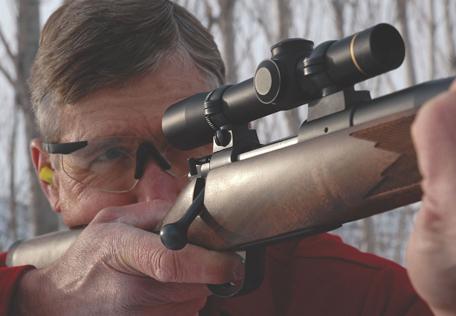
Leupold starts its second century with a new variable scope. Appropriately, the name reflects the year. VX-7 scopes feature European-styleeyepieces and new “lift and lock” windage and elevation dials. The power selector ring is matched to a “Ballistic Aiming System” so you can tailor magnification and reticle to the target and distance. Like other new Leupold scopes, this series has the matched-lens system that delivers extra-sharp images. Argon/Krypton gas has replaced nitrogen in the tube, to better prevent fogging. Leupold’s lifetime warranty comes with every VX-7.
The FX-III 1x14mm Prismatic sight that debuts this year should appeal to deer hunters and tactical shooters who must get on target fast. Its long eye relief, wide field and compact profile make it ideal for shotguns, carbines and AR15-style rifles. It’s a natural pick for muzzleloading rifles. The FX-III1x14mm Prismatic has fully multi-coated optics and a bold circle-dot reticle with illumination module. It’s rugged too. This sight survived a ride on a test machine pounding it with the recoil of a 375 H&H – 28,000 times!
Binoculars are getting more and more attention from the Beaverton, Oregon firm. Leupold’s top-rung Golden Ring Binocular has new HD objective lenses for 2007. Expect even brighter, sharper images from the HD (high definition, ED, extra-low dispersion, fluorite) glass. Phase-corrected prisms ensure true, crisp colors. The Golden Ring binocular comes in 8×32, 10×32, 8×42 and 10×42 configurations.
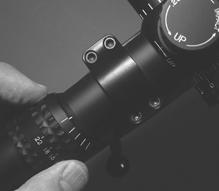
A close relationship with the Boone and Crockett Club inspired the new Pinnacles binoculars, with phase-corrected prisms and “L-coat” to reduce light loss on lenses and prism faces. These roof-prism 10×50 and 12×50 glasses come with flip-backframes and a neck strap, in a carrying case. The new Yosemite is an 8×30 that joins a 6×30 of the same model name. Its wide interpupillary adjustment range suits it to a variety of faces. Like the 6x, this glass has a slender profile and weighs less than lunch. It carries easily on a neck strap but gives you nearly 4mm of exit pupil.
For its 100th year, Leupold is marketing Cascades, Olympic and Pinnacles roof-prism binoculars in what it calls a Natural finish. It’s a tan hue that should appeal to hunters wearied by green, black and camo binocular jackets. The company also offers 8×30 Yosemite and 10×42 Cascades glasses in Shadow Brown, with a laser-engraved logo of the National Wild Turkey Federation. Visit leupold.com.
Millett
Known more for its rings and bases than its scopes, Millett has been trundling along with a modest line of serviceable scopes that won’t strain your budget. This year it has substantially expanded the line to include new Target and Varmint models. They wear side-mounted parallax dials and target knobs. Optional illuminated reticles include a mil dot. Like the Buck Gold and Buck Silver hunting sights, new 416x and 6-25x Target and Varmint scopes have 1-inch tubes. The Tactical series, augmented this year by a new 10x and a 1-4×24 variable, feature 30mm tubes. Lighted reticles for these and Millett’s 4-16x Tactical include a Donut-Dot. There’s also a Zoom Dot red-dot sight in the 2007 lineup, proofed on the S&W 500 revolver. Consistent with a trend to mounting scopes on Picatinny rails, Millett now offers its own rails for popular centerfire rifles. The company still markets a wide variety of iron sights for handguns. Go to millettsights.com.
NXS rifle-scopes cost a lot, and the Nightforce people make no apologies. Their aim is to produce the best sights possible for both sportsmen and tactical applications. So the best materials come together in scopes designed to endure more abuse than any shooter could imagine imposing on a rifle-scope. Tests at the north-central Idaho firm include submersion in 100 feet of water for 24 hours, freezing in a box cooled to a minus 80 degrees F, then heating within an hour to 250 degrees F. Every scope is slammed in a recoil device delivering 1,250 Gs – both ways. Life is tough for scopes at Nightforce!
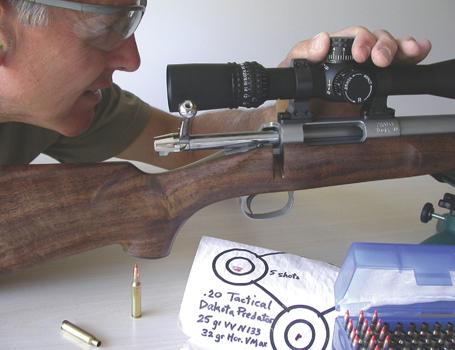
Details matter, too. The firm installs dissimilar alloys in the erector assembly to ensure repeatable movement. Lens coatings weather mil-spec abrasion tests. The 3.5-15×50 and 3.5-15×56 are typical – big 30mm scopes, and brilliant, with signature Nightforce reticles that appear only in the field’s center. You’ll find four-times magnification in other models as well: 5.5-22×50, 5.5-22×56 and 8-32×56. There’s a super-high-power 12-43×56 – but also hunting-size compacts: a 1-4×24 and a 2.5-10×24 (that’s right, a straight front end on a 2.5-10!) Nightforce sights have turret-mounted parallax knobs (except two benchrest scopes, an 8-32×56 and a 12-42×56, which wear front-sleeve parallax adjustments). The Precision Benchrest scopes feature resettable ? minute windage and elevation dials.
The company also supplies machined rings and Picatinny rails for mounting, and mil-radian knobs for NXS scopes so you can adjust in mils (.1 mil per click, 5 per revolution). There’s even ballistic software so you can get the most out of your scope at long range. Visit NightforceOptics.com.
Nikon
At 26 ounces, the new Nikon IRT 4-12×42 is half a pound heavier than many scopes of its power range. But then, it incorporates a laser rangefinder that delivers 1-yard accuracy to 400 steps – and reads almost that accurately out to 800. The rangefinder, operated by the touch of a button accessible as you aim the rifle, gives you continuous readouts on moving game. A Ballistic Drop Compensating reticle helps with holdover. The IRT mounts low on most hunting rifles, is fog-proof and gives you 3 inches of eye relief.
For 2007, Nikon has overhauled its flagship Monarch rifle-scope line. Each scope has a four-times power range and 4 inches of eye relief. From the 2.5-10×42 to the 6-24×50, all scopes have one-piece main tubes and accept Nikon sunshades. Quarter-minute clicks are standard on four models, eighth-minute on the 5-20×44 and 6-24×50. Sunshades and target-style adjustments come on these two models, as does a turret-mounted parallax knob, also standard on 3-12×42 and 4-16×42 versions. The BDC reticle is available on all six. In addition, Nikon offers a new Monarch X series with 30mm tubes. The 2.5-10x and 4-16x come with either Nikoplex or mil dot reticles, both etched. The 2.5-10x is also available with an illuminated mil dot. A turret-mounted parallax knob is standard on Nikon Monarch X scopes.
To learn more about these scopes, the Nikon Buckmaster line and a new Slughunter 3-9×40 scope with a “BDC 200” reticle (rangefinders, spotting scopes and binoculars too), go to nikonsportoptics.com.
Pentax
Having spent a couple of seasons afield with the Pentax 8×32 DCF, I’m impressed by its sharp and bright images. The DCF roof prism series comes in 8x and 10x magnification, with objectives of 32mm to 50mm in diameter (you’ll also find a 12.5×50 and 8×25 and 10×25 compacts). DCFs offer phase-corrected prisms in aluminum and polycarbonate shells. PCF Porro prism glasses in 8×40, 10×50, 12×50 and 20×60 versions remain in the line – a concession to those of us who prefer them to the more popular roof prisms. XCF Porros in 8×40, 10×50, 12×50 and 16×50 carry most PCF features at lower cost.
The Lightseeker rifle-scope series grew last year with the addition of a top-end Lightseeker 3-9×40 XL, and a compact Lightseeker 3-9×32 SL. The Gameseeker stable also appeared; for 2007 it has expanded to include eight 1-inch variable models and 4×32 and 6×42 fixed-power sights. A Whitetails Unlimited line offers mid-priced scopes from 3-9x to 6.5-20x. The big Lightseeker 30 series includes a 3-10×40, 4-16×50, 6-24×50 and 8.5-32×50. The Pioneer label covers affordable 3-9×40 and 4.5-14×42 scopes. Pentax has also developed a 2.5xSG Plus scope for slug guns and woods rifles.
Pentax’s PF-65ED, which just finished its first season afield, is a top-quality spotting scope with straight and angled eyepieces. Waterproof and lightweight, it accepts 32x, 46x and 20-60x eyepieces. The 37ounce scope is compatible with XW telescope eyepieces and the PF-CA35 camera adapter for 35mm SLRs. It joins the excellent PF-80ED and PF-100ED spotting scopes with interchangeable eyepieces, and the more compact PF-63Zoom with fixed 20-50x eyepiece. For more details, go to pentaxsportoptics.com.
Schmidt & Bender
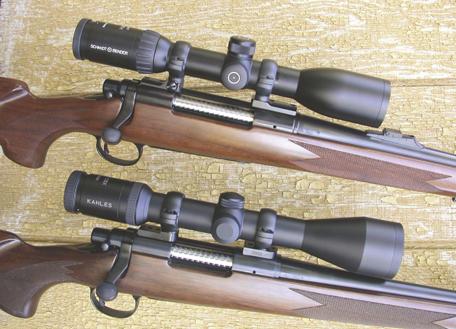
It’s been fifty years since a couple of German instrument-makers collaborated to produce hunting sights. Since then, Schmidt & Bender optics have become renowned for their high quality, the company for its innovation. No, it’s not a big firm. My first visit to the plant in northern Germany conjured images of a rural veterinary clinic or college chemistry lab. The modest building lacked any industrial aspect. White-frocked technicians ghosted through spotless rooms. Scopes were tended individually, not in big batches.
Schmidt & Bender’s flagship line is the Zenith, with 30mm variables in power ranges 1.1-4×24, 1.5-6×42, 2.5-6×56 and 3-12×50. Resettable windage and elevation knobs have gauges on the dial faces to show where in the span of adjustment you are. So you can use the mount to center the optical axis in the physical axis of the scope, maximizing adjustment range. A ring under the dial face allows you to record several zeros, for quick return when shooting different loads or at various ranges. Zenith scopes come with a hollow mounting rail or, consistent with American tastes, configured for rings.
S&B’s Zenith line offers illuminated reticles. My favorite is the FlashDot, which disappears from your field of view when you choose to use a black reticle. In dark conditions, switch on the Flash Dot and adjust brightness with the rheostat. A beam splitter puts the dot in the very center of the field. An automatic switch kills the dot after six hours to save battery. S&B offers traditional illuminated reticles in the Classic 30mm series 2.5-10×56, 312×50 and 3-12×42, and in the 8×56. The 4-16×50, 6×42 and 10×42 come with a selection of standard reticles. Depending on the model, Schmidt & Bender variables and fixed-power sights have reticles installed in the first or second focal plane. All are mechanical, save for the #9, which is etched onto the glass. Parallax is zeroed at 109 yards. S&B can retrofit illuminated reticles on some of its earlier and current-production scopes.
If you’re a traditionalist, you might agree with me that Schmidt & Bender offers some of the most appealing fixed-power scopes available. Long ago I snared a 4×36; the 6×42 and 10×42 are next on my list. If you prefer tactical sights, S&B’s 34mm 3-12×50 and a new 4-16×42 merit a close look. The 3-12x was recently adopted by the U.S. Marine Corps for all its 30- and 50-caliber sniper rifles. Schmidt & Bender’s entire PMII (Police Marksman) line, and its hunting scopes, can be viewed at schmidt-bender. de or on the web site of its U.S. importer: [email protected].
Shepherd
The 3-10×40 and 6-18×40 scopes from the Shepherd shop in Waterloo, Nebraska afford you long-range capabilities not shared by any other scopes. Shepherd sights have two reticles, one in the front focal plane and one in the rear. Superimposed, they appear as one. You get an aiming reticle that doesn’t change size with power changes, but a rangefinding reticle that varies in dimension as you turn the magnification ring. The rangefinding reticle comprises a series of circles spaced on a vertical stem. Top to bottom, they’re of decreasing diameter to match the diminishing apparent size of a deer as distance increases. To determine the distance, just fit a deer-size target into a circle. Correct holdover has already been factored in because no matter what the scope power, the 18-inch circle (in the front plane) appears the same size in relation to the target. Choose from three rangefinding reticles calibrated to match the trajectories of popular big game cartridges. Vertical and horizontal scales are marked in minutes of angle so you can compensate for wind as well as gravity. The company also sells binoculars, but the scopes are truly remarkable. A friend whines that coyotes between 400 and 500 yards are no challenge for his Remington 25-06 and a 6-18x Shepherd. Some people just like to complain. Shepherdscopes.com.
Sightron
A relative newcomer to the hunting optics industry, Sightron was incorporated in Florida in 1993. Two years later it moved to North Carolina and opened its first distribution center. Its initial products were red-dotsights; a year later it announced a line of 1-inch rifle-scopes. A year after that, binoculars appeared in the Sightron stable. Spotting scopes followed shortly. In 1999 CEO Scott Helmer hired Alan Orr as the company’s product manager. I’ve known Alan since 30mm scopes were added in 2000. Line extensions thereafter include Premium binoculars and S1 scopes, and in 2007, SII Big Sky scopes and binoculars.
The Big Sky series comprises 15 offerings, from fixed-power 4x and 6x glass to variables 16x at the top end. They’re fully multi-coated. External lenses are all treated with “Zact-7,” a seven-layer coating to transmit the most light possible. They also get a hydrophobic wash to disperse moisture when you’re out in the rain. Adjustment dials are finger-friendly and resettable. Eye relief is a generous 3.8 inches. Retail prices start at $420. In addition to the 15 hunting scopes, Sightron catalogs a pair of new varmint sights in its Big Sky line. They’re 6-24x42s, identical save for the finishes (stainless and black). Both feature target knobs, adjustable objectives and plex reticles. A late addition under the Big Sky umbrella is a Dangerous Game 1.25-5×20 sight with over 6 inches of “clear tube” for mounting. Like the other sights in the line, it has a one-piece tube and comes with a lifetime replacement warranty.
There’s a new target scope in Sightron’s 2007 catalog, a 36×42 with ?-minute adjustments and ? minute dot. Adjustable objective, too.

Sightron’s 30mm S III-series includes a 3.5-10×44 scope, plus three 6-24×50 models. Choose a Plex, Dot or Mil Dot reticle. Fixed-power aficionados will appreciate the modestly priced SII 4×32. Deer and turkey hunters can well use the broad field and 4 inches of eye relief in the newest shotgun scope, the 2.5x32SG. Two lightweight red-dot sights feature 1x magnification and 33mm tubes.
The Big Sky moniker has been applied to Sightron’s newest binoculars, all Porro-prism. The 7x, 10x and 12x have 50mm objectives. So does the new SI 18-36 spotting scope, a lightweight (20-ounce) and field-worthy glass that comes in a kit with aluminum hard case and swivel pan-lever tripod. Sightron.com.
Swarovski
“We don’t want to shoot a bull near cover, or stretch the reach of that ought six.” Fred obviously didn’t approve of my rifle, a new Remington 700 Alaskan Ti. But I had fallen for it. On the range it drove 180-grain Swift Sciroccos from Remington loads into 1x-inch groups with comforting consistency. Well balanced and with a sleek, open-gripped stock, it handled beautifully. I had scoped it with a new Swarovski Z6, a scope whose top magnification was fully six times its low power!
The new scope nestled tight to the Remington in Leupold rings. In shooting I’d done to ready this outfit for Texas, I’d been impressed by the scope’s flat field and crisp, brilliant images. Optically, it was indeed top-drawer. The adjustments tracked true as well. Shooting “around the square,” I got predictable movement grabbing 20 clicks to a shift. The last group trampled the first.
The nilgai was alone, tucked into a protected slot in the mesquite. I slipped alongside the thicket crosswind, probing for a shot alley. At just 35 yards, an opening appeared. I knelt and pressed the trigger. As intended, the Scirocco severed the spine between the scapulae, dropping the bull instantly.
He rose 80 steps away, almost too far. Brush took my first bullet, and the second. I caught a bigger alley with the third and dropped him with a Hornady bullet to the shoulder.
My scope that day was a Trijicon variable, with a lighted reticle. The red tip of the post, lit not by batteries but by tritium and a fiber-optic coil, was easy to find against the mottled background, and quick to find again as I recovered from each shot. The fiber-optic coil, by the way, was exposed in a window atop the eyepiece. Adjusting reticle brightness was a simple matter of rotating the window cover open or closed.
Trijicon is a relatively new company. Even the technology is recent. Not until 1983 did the U.S. Nuclear Regulatory Commission approve a tritium-illuminated gunsight for sale. Two years later the first rifle-scope with a tritium reticle appeared. In 1987 Trijicon introduced the ACOG (Advanced Combat Optical Gunsight) to the U.S. armed forces. The next year, the FBI adopted its tritium sights for handguns.
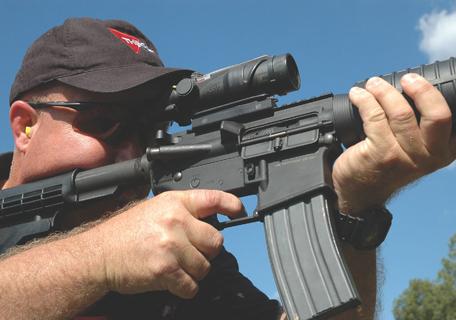
In 1995, after many sales of tactical sights, Trijicon’s 4×32 ACOG was selected by our Special Forces for the M-4 carbine. Now Trijicon optics appear on many military and police weapons. Glock, Smith & Wesson and Springfield offer Trijicon iron sights as standard equipment on their handguns.
The company’s optical sights for hunting rifles use both tritium and fiber optic strands to brighten the reticle. The 30mm TR22 2.510×56 AccuPoint I carried on the Colorado elk hunt is one such sight. The AccuPoint scope series comprises 1.25-4×24, 3-9×40 and 2.5-10×56 models, with red or yellow illuminated pyramid-on-post reticles. The Trijicon TriPower relies as well on a fluorescent collector. Like the ACOG, it has the profile of a red-dot sight. You can also get a compact Trijicon Reflex sight that hugs a handgun. For 2007 the Wixom, Michigan company has announced two new ACOGs and a parallax-free red-dot sight that should complement any short-range firearm. Go to trijicon.com for more information.
TruGlo
A year ago in Utah I had no luck finding a buck to match the one I’d shot the year before with an iron-sighted muzzleloader. That buck had jumped in cover that swallowed him up before I could get into action. I’d followed his tracks in the snow, through impossibly thick oak-brush. By great good fortune, he paused in an opening 100 yards ahead, and I managed to slide a sabot bullet between the limbs. He dashed off but collapsed in a flurry of snow at the top of a nearby hill.
My TruGlo sights, so effective at milking more minutes of hunting at day’s end, had given me the definition I needed for a quick shot in sunshine too bright for ordinary sights.
TruGlo’s fiber-optic bars concentrate light to give you a bright red or green dot that grabs your eye. Available for most rifles, pistols and shotguns, the firm’s iron sights were recently joined by four rifle-scopes – a 4×32 and three variables – with illuminated reticles. There are red-dot sights on 25-, 30, 36-, 40- and 45mm tubes. The most recent: a 2x30mm that features an 11-position rheostat. There’s more on 2007 products at truglo.com.
Vortex
Still new to the shooting public, Vortex optics comprise a broad selection of binoculars and two lines of rifle-scopes. The 2007 Viper series includes six variable sights, from 2-7×32 to 6.5-20×50. High-powered models include turret-mounted parallax adjustments and target knobs. All Vipers feature argon gas, fully multi-coated lenses, resettable windage and elevation dials, a fast-focuseyepiece and one-piece tube. The five offerings in the less costly Diamondback series range from a 1.75-5×32 to a 4-12×40. They too are fog-proofed with argon gas. You also get helical eyepieces, resettable dials and fully multi-coated lenses. Find out more at vortexoptics.com.
Weaver
Meade Optical, a California-based maker of telescopes, got into the rifle-scope trade a few years ago with the purchase of the Weaver, Redfield and Simmons brands. Meade chose to upgrade the Simmons line first. The Simmons overhaul went well. Engineers Mark Thomas and Forrest Babcock reconfigured the innards of the best models and renamed them. Then the design was applied to other Simmons scopes. As I understand it, these sights have sold well. Meade’s next target was Redfield, a brand with a rich history and enviable reputation. A Redfield scope with five-times magnification appeared in prototype form a couple of years ago. But not everything in this new sight turned out as the Meade group (or shooters who examined the scope) desired. Since then, progress toward commercial production has been slow.
Improving Weaver scopes would entail less engineering – but even more risk. The name survives as an American institution, dating to early Depression times, when a clever young Bill Weaver fashioned a rifle-scopefor the masses. His Weaver 330 seems primitive now, but it beat its competition at market. In short order Weaver built a successful company in Texas. In my youth, 30 years later, the Weaver K4 still loomed as the standard by which other scopes were judged. It retailed for $45.
You can still buy a K4, though Bill Weaver is gone and scope production was long ago moved to Japan. Weaver scopes still deliver good value. Classic K- and V-series sights, and Classic Handgun scopes, round out a selection of hunting optics anchored now by the Grand Slam series, with models from 1.5-5×32 to 6-20×40 that cover any field application. T-series target scopes rank among the most popular Weaver (or its competition) has ever produced. Two recent T-24s are identical save for reticles: a x- minute dot and a x-minute dot. Their x-minute windage and elevation target-style adjustments allow for fast zeroing or compensating for wind and range. Dual-spring adjustment mechanisms ensure repeatability. New T-series scopes come with extra oversized adjustment knobs, a sunshade and screw-in steel lens caps.
For 2007 Weaver has introduced a new Extreme line of top-quality rifle-scopes. Functionally and cosmetically, they offer many upgrades. The 1.54.5 x 24, 2.5-10 x 50 and 2.5-10 x 56 feature 30mm tubes, fast-focus eyepieces, an illuminated dot in plex and German #4 reticles. They have resettable windage and elevation dials, a full 4 inches of eye relief. The 2.5-10x models carry turret-mounted parallax dials. Go to weaveroptics.com for a complete product tour.
Williams
As a youngster growing up in Michigan, I knew the Williams clan – the generations of shooters and hunters who’d established a gun-sight company in Davison. Now, 81 years after its founding, I’m very pleased to see the firm still catalogs an extensive array of iron sights. You can fit your rifle or slug gun with a 5D receiver sight (though, alas, they no longer cost $5). The FP (foolproof) series comes with sleek screw adjustments or target knobs. WGRS sights fit receiver dovetails and topside factory-tapped holes. I killed my first deer with a Williams “African” open sight. Its shallow V-notch cradled a gold bead on a Williams front ramp. Very fast!
Those items are all available in 2007, with new fiber-optic sights for pistols and long guns. Williams also makes scope mounts and gunsmithing tools, and accessories like full-moon clips for revolvers, Garand clips and barrel slot blanks. Visit Williams on the range or at williamsgunsight.com.
XS goes Tritium
More than a decade ago, when I equipped woods rifles with Ashley sights, I thought them among the best I’d ever used. Simple, strong, clean-looking and compact, with clever adjustments, they seemed the perfect complement to slug guns and muzzleloaders as well. Since then, the company has changed its name a couple of times. But as XS Sights, it still makes some of the best irons out there. The line has expanded to include open sights for rifles and pistols. The shallow V rear notch with white center-line is ideal for game in thickets, where shooting is fast and close. The receiver-sight line has grown to include ghost-ring models for most popular long guns. Tritium inserts in beads and open rear sights speed shooting in dim light. This “glow-in-the-dark” option appears under the “24/7” heading in the XS catalog and at xssights.com.
Zeiss
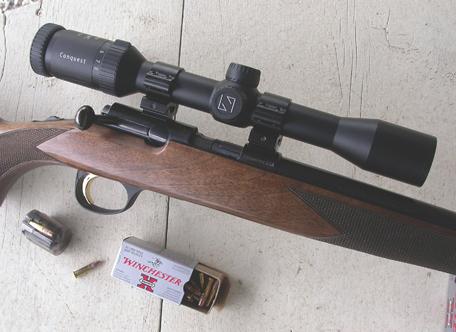
Five years ago, Zeiss courted hunters Stateside with a new line of 1-inch rifle-scopes. Conquest scopes in 3-9x, 3.5-10x, 4.5-14x and 6.5-20x came first. In 2006 4 x 32, 2.5-8 x 32 and l.8-5.5 x 38 appeared. The 4x and 2.5-8x weigh less than 14 ounces, and both boast 4 inches of eye relief. The 4 x 32 is one of my favorite big game scopes, the 2.5-8x as trim and even more versatile.
The company’s Diavari scopes were recently brought under the “Victory” moniker to match that of top-ranked Zeiss binoculars. The Varipoint is optically equal but features an illuminated reticle. Recent 2.5-10 x 42 and 6-24 x 72 scopes have 30mm and 34mm tubes, respectively (there are five Varipoint and six Diavari sights). An illuminated reticle is standard on the big 6-24 x 72, as is a turret-mounted parallax dial. The mil dot reticle option is calibrated at 12x. The Zeiss Varipoint reticle is also available in the 2.5-10x; so is a rail-equipped tube. Incidentally, Zeiss also lists a Classic Diavari/ Diatal series (variable/fixed-power) that can cause some confusion if you’re trying to track name changes. These scopes are marketed in Europe but not in the U.S.
Late in 2006 Zeiss started releasing its Diarange scope, a 30mm Victory-series 3-12 x 56 with laser rangefinder built in. This scope weighs 35 ounces, is optically superb and as cosmetically appealing as any sight of its type can be. The rangefinder reads reflective objects to 1,000 yards a half-second after you press a button. Now the Diarange also comes in a 2.5-10 x 50 version that scales 32 ounces. Both sights operate on a single 3-volt battery and feature a choice of seven reticles, including several rangefinding configurations. In 2007 Diarange and other Victory products (binoculars too) will carry hydrophobic LotuTec lens coating, a treatment that beads water for a clear view in rain.
As a follow-up to the compact red-dot Z-Point sight, Zeiss has just introduced a version that affixes to a bow for archers. Another one-of-a-kinditem this year is the Zeiss DC4 camera-eyepiece you can attach to a Diascope spotting scope. The device allows you to photograph directly through the scope. It features a bayonet mount, operates on two 1.2volt AA batteries and has a 2-inch display screen. You can trigger the 4-megapixel camera with a remote control. Visit Zeiss.com/sports.
Editor’s Note: This article appeared in the 2008 edition of Gun Digest annual book.

Next Step: Get your FREE Printable Target Pack
Enhance your shooting precision with our 62 MOA Targets, perfect for rifles and handguns. Crafted in collaboration with Storm Tactical for accuracy and versatility.
Subscribe to the Gun Digest email newsletter and get your downloadable target pack sent straight to your inbox. Stay updated with the latest firearms info in the industry.