• Free Revolver MagazineChoose Your
    Download
    Get a digital revolver magazine when you sign up for our FREE email newsletters and store specials.
 

AR-15 Scopes and Optics

FavoriteLoadingAdd to favorites

Editor’s Note: This article is an excerpt from Chapter 7 of the Gun Digest Book of the AR-15, Vol. II. To download the full chapter in digital format, CLICK HERE. Or learn more about the full book download CLICK HERE.

Download a Digital PDF Version of the Gun Digest Book of the AR-15 Vol. II
A Famous Maker 2.5-10X scope, in an Armalite mount, turns in an excellent group with Wolf ammo out of the S&W M&P-15. Bet against this combo at your peril, as it will kick your butt in competition.

If I’m spending an afternoon on a ridgeline over a prairie dog town and my scope breaks, I can get another out of the truck. (Ri?e or scope, my choice.) Or come back another day.

If the bad guys are shooting at me and my scope breaks, I might not have the option of going back to the truck. As for the option of coming back another day – well, things don’t work that way.

Scopes selected for military use tend to be heavier, bulkier and a lot more costly than what would be “good enough” for hunting. That’s why you see bullet-proof rings like LaRue and Badger Ordnance on military ri?es, and honkin’ big scopes like Leupold or the European makers.

A few ounces, or even a pound, of extra weight don’t matter in those circumstances. Consider the situation of a squad designated marksman (or even a school-trained sniper) in a small group of SpecOps troopers, hiding on a ridgeline.

Download a Digital PDF Version of the Gun Digest Book of the AR-15 Vol. II
Aimpoint makes tough optics. They must; they’ve sold literal truckloads to DoD.

Between the bunch of them, the government has spent a staggering amount of money: they all draw pay (not enough, in my opinion) and have since they enlisted. They’ve been fed, housed, clothed, and sent to an impressive number of schools. They’ve been through training exercises that cost bundles of money. Then, the government ships them and all their gear halfway around the world. Going over on a C-5A or a C-17 costs a lot more per-person than ?ying coach on a commercial airliner. Then, they took a helicopter ride. That chopper requires another group of people; pilots, maintenance techs, air traf?c controllers, all of whom cost the government a lot of money. Lying there in the dust, each one of those SpecOps troopers represents a million dollars or more of invested money.

Do you really think, once you start considering the costs, that the government really cares that another scope is “just as good” and costs “hundreds less”? If the troopers miss because the scope croaks, then the government may have to marshal millions more in air-delivered ordnance, artillery or drones.

My only surprise is that there isn’t a “ball peen hammer” mil-spec test. You, however, do not have that luxury. You may well ?nd that a less-expensive scope (optic or red-dot) serves your needs just ?ne, and at much lesser cost. Lesser cost is good, if the savings are spent on practice ammo. Buy as good a scope as you can afford, but always buy enough ammo to be in practice.

Optics and Choices

With optics, you can spend for the best, and nothing less. Or you can get optics that are good enough, and put the rest of your money into practice ammo. The Marine Corps (one of those groups sending people to exotic places) has decided the Schmidt & Bender scopes are all that will do.

Even with the volume discount, they are spending a lot on glass. If you’re prepared to spend that much, you’ll get optics that will knock your socks off. But so will the price.

Leupold

Leupold & Stevens makes ?rst-class optics, and if you’re serious about shooting then they should be the scopes you use. Yes, there are better optics, but you’ll pay, and pay dearly, for better optics.

I covered them in Volume 1, so I need not review them again. I did, however, hang on to them to use them in this book too. That’s how good Leupold scopes are.

Famous Maker

For those not needing (or needing yet) optics in the “make your wallet bleed” category, Famous Maker offers entirely serviceable optics. Well, some are. While I would get Leupold optics sight unseen, you should look through lesser optics before buying.

Famous Maker sent me two scopes. One, a compact 2-6X that looked perfect for the AR, proved not to be. The eye relief is so short that I was hard-pressed to mount it far enough back to be able to see through it. And the center portion of the scope was the only part usable. Outside of the center, the ?eld of view had noticeable distortion.

Until they make a “MkII” of this scope, pass on it. And I had high hopes for it, too. However, the 2.5-10X Tactical scope is different. Bright, clear and with a mil-dot reticle, it proved quite up to the task of shooting small groups from the bench.

Upon arrival I slapped it on the S&W M&P-15, and proceeded to bang a dead-center group sub-MOA with Wolf Performance ammo. The Wolf ammo is an M-193 equivalent, and I have not had it fail to work properly in any of over a dozen ri?es. The S&W loves it.

The Famous Maker 2.5-10 suffers from the same fault that a lot of “not the most expensive” optics suffer from: narrow eye relief. Any scope you get that isn’t Leupold quality (and thus price) or greater will suffer from narrow eye relief.

The scope is a one-inch tube with a 44mm objective. You can get the basic scope for about a hundred dollars, or you can get the illuminated reticle one for two hundred. As an entirely serviceable practice/learning scope, before you spring for your $1200 scope, consider the FM 2.5-10X. It has a lot going for it.

OSTI

Download a Digital PDF Version of the Gun Digest Book of the AR-15 Vol. II
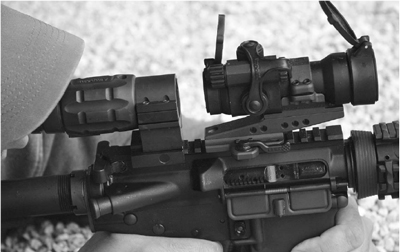
The LaRue M-68 CCO or “gooseneck” mount gets the Aimpoint forward of any NVG you might mount.

Optical Systems Technology, Inc., makes perhaps the coolest thing a poor, underpaid gun writer gets to play with: an AN/PVS-22 night vision scope. For those of you who have not updated your knowledge since reading of the “starlight” scopes of the Vietnam War, hold on.

We’ve 35 years of updating to do in a couple of paragraphs. A night vision scope is basically a television camera. Inside it is an extra electronic array known as a “photomultiplier.” The p-m is an ampli?er.

When it gets “hit” by a photon on the front (actually, it takes more than one, and the sensitivity of an NVG device is dependant on the threshold of light it reacts to) it responds by squirting ten, a hundred, a thousand out the back. The smaller the photo-sensitive locations on the p-m, the greater the resolution. The greater the ampli?cation, the more it sees.

However, you can’t get something for nothing. Early NVGs suffered from “bloom” which is an over-amping of the p-m, causing the whole screen to wash out or have haloes around light sources. Early screens also suffered from “burn-in” in the same way early computer screens did.

Having a high-resolution NVG suite simply means you own the night. Our military owns the night. NVG are also sensitive to infra-red light. So the I-R lasers on every other ri?e, vehicle and lamp-post allow our NVG-equipped soldiers, Marines and airmen to see even in total darkness. (Of course, someone else with NVG can see the “?ashlight” effect of the IR laser, too.We are not alone in making NVG.

However, we are the best. When the ?rst Russian NVG scopes appeared on the market, they were simply awful. I mounted one for a customer and attempted to bore-scope it. All I got for my efforts was a splitting headache.

Trying to discern objects in the dark, grainy, out-of-focus screen was enough to make you crazy. Some users even joke about needing lead shorts to stop the radiation rumored to be coming from them. Newer ones are much better, but still not as good as American NVG. Of course, better costs more, and the best are in use overseas.

What OSTI sent me was their Universal Night Sight, which mounts in front of regular optics. As the AN/PVS-22 is a television camera, you can’t look “through” it when it isn’t on. NVGs don’t work in the daytime. (The military has special day/night scopes but they make regular NVG scopes look inexpensive.) So, the OSTI has a quick-removal mount that lets you attach it directly to a rail in front of a scope.

Since the UNS simply transmits an image back, and your regular scope hasn’t been moved, you don’t change your zero. You simply attach and turn on the UNS.

When I showed it to a friend of mine who is a Chief of Police, he and several other departments were in the process of looking at NVGs for disaster preparedness. He took one look through the OSTI UNS and remarked, “This is worth the price of admission.” And it is.

The view is clear enough to read license plates across a parking lot. On a hazily-overcast night out at a military base, I was able to see the stars through the cloud cover, and identify the constellations.

I had a great deal of fun with the UNS OSTI sent me. I ?rst mounted it on my “Police Sniper” 6.8 Remington SPC ri?e, and it is a hoot to use. Given even a slight amount of light from someplace (the stars will do, even a sliver of moon is enough to make the world light up) I had no problems whacking gongs or dropping the computer pop-ups on the NG base.

What I found was that the OSTI AN/PVS-22 turns on ?rst at the highest gain, and the best setting for me (and many others) was with the gain turned down. Way down. Too much gain interfered with resolution and was tiring to look at for any length of time. I’m sure turning down the gain increases battery life as well as increasing “eye endurance.”

However, I have yet to use up the two AA batteries I put in to start this “research” so battery life is obviously not a problem. And you can ?nd AA batteries at any location on earth. If there is a store with batteries, they have AAs.

Download a Digital PDF Version of the Gun Digest Book of the AR-15 Vol. II
The original AR optic, a Colt-procured 3X scope that ? ts on the carry handle. Better than nothing, but not by much.

Once I’d played with it for a while on the 6.8 Police Sniper I then mounted it on the 5.56 DMR. Since the UNS simply transmits its image back to the scope, you can swap it from ri?e to ri?e without a change in zero. The UNS was even more fun on the DMR. If you had a DMR, a UNS and IR-trace 5.56 ammo, you could indicate a position for someone else with NVG. Thinking about that in a military context (and IR lasers) gets downright scary. Scary for the other side, that is.

The downside? Cost. You’re going to be spending thousands of dollars at the very least. Six or eight, probably. If you buy more, the unit cost comes down, but you’ll have a heck of a time ?nding ?ve or six friends who also want night vision gear.

Of course, for many of us, that isn’t that much for something this fun. And from someone doing predator control, the expenditure is recouped pretty quickly in prevention of cattle losses. If you want something smaller OSTI makes the TaNS, the Tactical Night Sight, which is petite compared to the bigger optics.

You want night-time fun, look into the OSTI UNS.  Lest you think they are just re-badged Russian optics, the UNS has a National Stock Number, and is listed with the Defense Logistics Agency.

Man, I hated sending it back. But what’s a poor, under-paid gun writer to do? (Besides take lots and lots of photos?)

Insights

Insights makes lights and lasers and is in the process of making an optical system. The IOSS is a red dot sight with integrated laser. At the moment of this paragraph it is still in R&D, and the original models appear to be LE or military use only.

But give them time, and there will be one for the rest of us.

Optics Bases

The ways to mount magnifying optics to an AR are legion. Well, there are a lot. At the low end, you could do something as simple as ?t a Weaver ring set to your M4 upper rail. Or bolt a Weaver adapter into the carry handle of your A1 or A2.

While the purists might look down on you (and the second method does have drawbacks) it gets the job done. The more durable, convenient and modern method is a throw-lever mount like the LaRue. Another approach is the GG&G lever, which clamps their bases or mounts to the top of your ?at-top AR with a single swing of a large lever.

At the top end, Badger Ordnance makes rings that are tougher than your ri?e. If you were to mount a scope to your AR with Badger Ordnance rings, and then beat the snot out of the ri?e and scope with a hammer, the rings would survive even after the scope and ri?e were scrap.

A real-world example would be an AR sniper ri?e being ejected out of a police car during a collision. The result was a scrapped ri?e and scope. But not the Badger Ordnance rings, which survived.

Most things that go onto your AR need mounts, but some don’t.

Red-dot Mounts

Download a Digital PDF Version of the Gun Digest Book of the AR-15 Vol. II
The GG&G gooseneck mount for the Aimpoint is solidly made and will look good on any AR.

Many red-dot mounts are simply built into the scope body. Others require a base and ring system. There are advantages and disadvantages to both.

What you’ll often see with the separate optics and mount system is that the mount is cantilevered forward. Also known as a gooseneck mount, the angle is there to increase usable real estate on the top rail of the ri?e. Unless there is a rail system on the handguard (and mounting scopes there can be chancy) you have to mount the scope on the rail. You also need room for the BUIS.

And in military use you often need a night vision gear or optic, too. By angling the red-dot optic forward you make room for the NVG. Since the red-dot has no need for eye relief, it can be anywhere. You could mount it at the muzzle if you wished, provided it stayed aligned with the bore.

The ideal mounting of the red-dot optic would put it in line with the iron sights so you would not have to change your cheekweld for one or the other. One advantage to non-magnifying optics is the ability to “co-witness” sights. Simply put, you zero your irons and you zero your optics. Then you turn on your optics and aim through your iron sights.

Note the relationship between the dot and your irons. They should agree as to the point of aim/point of impact. Once done, you can check your sights at any time.

Let’s say your ri?e takes a tumble. If you think your optic or irons took the hit, turn on the optics and aim through your irons. (In a safe direction, please!) If your sights no longer agree as to point of aim/point of impact, then something is amiss.

If you know which took the impact, then that’s likely the one damaged. If you don’t, at least you know one of them is wrong, and can set about ?nding and correcting.

Red-Dot Scopes

The beginning of red-dot scopes in practical competition began with Jerry Barnhart in 1990. He mounted an Aimpoint on a .38 Super Open gun and proceeded to win the Nationals with it.

Later that year, Doug Koenig, having mounted a red-dot scope on his Open gun, won the World Shoot. After that, there was no going back. Well, at least not for a few years.

The original scopes were dim, had narrow tubes and were quite fragile. It was not unheard of for a competitor to have two or three pre-zeroed scopes in their gear bag. Should one decide to break, they’d unbolt the old one and install the new one.

Download a Digital PDF Version of the Gun Digest Book of the AR-15 Vol. II
The Aimpoint with the twist-off 3X adapter, being used to slam LaRue targets far downrange.

I recall one time, at a USPSA Nationals, after a hard rain the sun came out. My extensively-modi?ed and unsealed scope fogged up. By holding a butane lighter ?ame against it, I was able to dry it out. We’ve come a long way since then, and Aimpoint has done a lot to advance the ?eld.

The method of operation of any red-dot scope is the same: you look through it, at the target. For fast, close-in shooting, you simply let the dot “?oat” in your ?eld of view. Where it is, is where you hit.

Optical purists quibble about which red-dots are and are not perfectly parallax-free. Parallax is the change in point of impact from the dot (or crosshairs) of a scope, when you move the dot or crosshairs from the optical center of the scope by moving your head.

A scope with parallax will have the point of impact away from the dot or crosshairs when they are near the edge of the ?eld of view. In a magnifying optic, parallax can be a problem.

Optically, the magnifying scope can be adjusted so it is parallax-free at a single distance. However, the effect is so small at distance that scopes can be said to be “parallax-free” at or beyond a certain distance when properly adjusted.

Target competitors fuss over it greatly. A scope adjusted to be parallax-free at ?fty yards will show parallax at 100, and vice-versa. When a change of fractions of an inch can mean lost points and lost matches, target shooters get fussy. The lack of magni?cation and the large dot size means that even a red-dot optic that is not well-engineered and has parallax hardly matters.

At worst, the parallax in a red-dot scope is not enough to move the point of impact out of the “shadow” of the dot. As one example, if the parallax error of a Brand-X red-dot scope is three-quarters of an inch at 100 yards, and the dot itself is 2MOA, then moving your head is not going to move the point of impact off of the dot. If the dot is on the target, you get a hit. And the parallax error may well be less than the accuracy limits of the ammo being used. So, the short explanation is: don’t sweat it.

If a manufacturer tells you their red-dot is parallax free, it probably is. And even if it isn’t, you aren’t going to miss your target because of it. At least not this side of 300 yards.

How red-dot sights work is also pretty much the same, with one big exception. Basically, a low-powered laser inside of the scope body re?ects off of an internal plate that is partially-mirrored. The mirrored plate does not interfere with seeing through the scope. (But does explain why red-dot optics are often a bit dimmer than outside light.)

You see the dot. You aim with the dot. At close range you use binocular vision, let the dot “?oat” and get your hits. At distance you mentally focus, see only the view through the scope, and put your dot on your target.
Download a Digital PDF Version of the Gun Digest Book of the AR-15 Vol. II
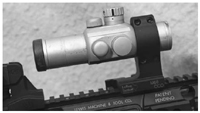
No, this isn’t a combo you’d see in Iraq. But with an accurate ri?e and a solid mount, a cheap scope serves until you’re practiced or can afford the better optics. Don’t be a slave to fashion.

The ability to look through an optic without seeing it is part of the “Bindon Aiming Concept.” The late Glyn Bindon ?gured out that a glowing dot against a black background was as good as transparent to the human brain when viewed with binocular vision. (Actually, our mind. Our brain is simply the mechanico-chemical processor of the thought processes of our sentience. But let’s not complicate things.)

By looking “through” an otherwise solid aiming device, you could shoot quickly and still be accurate. Even though you can look through most red-dot optics, your mind is following the same pattern that Glyn ?gured out.

Some competition shooters use this concept with magnifying optics. If they have a scope with a battery-powered or ?ber optic enhanced aiming point, they will close the front scope cover on a magnifying scope.

The result is an opaque optic they can aim “through” using the Bindon Aiming Concept. They get both a magnifying optic when they want it, and a red-dot when they need it.



Download a Digital PDF version of Chapter 7 - Scops and BUIS, from the Gun Digest Book of the AR-15 Vol. II - Click Here!  This article is an excerpt from Chapter 7 of the Gun Digest Book of the AR-15, Vol. II. To download the full chapter in digital format, CLICK HERE. Or learn more about the full book download CLICK HERE.


Related Posts:

Patrick Sweeney About the Author: Patrick Sweeney is the author of many of Gun Digest books' best-selling titles, including Gun Digest Book of the 1911, Vols. I & II; Gun Digest Big Fat Book of the .45 ACP, Gun Digest Book of the AR-15, Gun Digest Book of the AK and SKS, Gun Digest Book of the Glock and Gunsmithing: Pistols and Revolvers, among other titles. A master gunsmith, Patrick is also Handguns Editor for Guns & Ammo magazine.

RSSComments (2)

Leave a Reply | Trackback URL

Leave a Reply

You must be logged in to post a comment.