
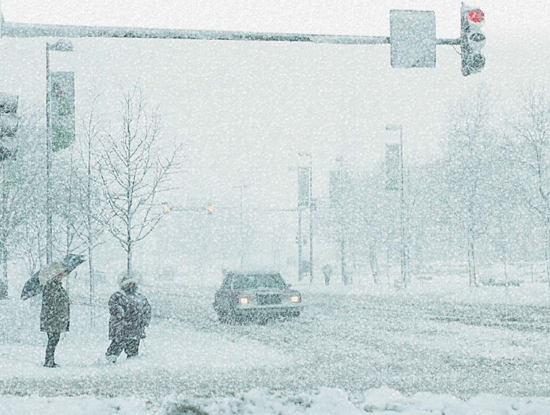
The Fargo-Moorhead area of northwest Minnesota was hit hard this week by something no one expected in early October: 14 inches of snow. It caught residents completely by surprise. Few had winter survival kits in their cars, putting many stranded motorists at risk. Homes were just as unprepared, as power went out across the region.
No one died, but the possibility certainly wasn’t out of the question. It’s time to start thinking about how to survive a blizzard.
The National Oceanic and Atmospheric Administration (NOAA) has some great tips for preppers, including how to survive a blizzard. With winter storms just around the corner for the rest of the country, it’s never been a better time to review.
Here are the NOAA’s recommendations, as condensed by Gun Digest.
How to Survive a Blizzard Outside
Being outside during a blizzard can be lethal. It’s not the cold so much as the disorientation. High winds and heavy snow reduce visibility, which increases the chance of becoming lost. That when things get deadly.
If Shelter is Available
* Stay dry
* Cover all exposed body parts
* Determine if there is some way to make the shelter visible to others
If Shelter is Not Available
* Build a lean-to, windbreak or snow cave for wind protection
* Make a fire for heat and to attract attention (this might be impossible, but the takeaway is that warmth will prevent hypothermia)
* If a fire is created, place rocks or other heat conductors around it to absorb and reflect warmth
* Melt snow for water
* Don’t eat snow, it lowers body temperature and invites hypothermia
* Find a way to attract attention to initiate a rescue
How to Survive a Blizzard in a Vehicle
* Stay in the vehicle, as it provides shelter and an easy way to be spotted by help
* Run the engine for about 10 minutes each hour for warmth
* Open the window a crack to keep air circulating in order prevent carbon monoxide poisoning
* Clear the exhaust pipe of any obstruction to keep fumes from entering the cab
* Move arms, legs, fingers and toes vigorously from time to time for warmth
Tips for Attracting Attention
* Turn on interior or exterior lights while the engine is running
* Honk the horn if help is close
* Tie a piece of cloth (eye-catching colors work best) to the antenna
* Once the snow stops, raise the hood to signal help is needed
How to Survive a Blizzard Inside
Houses offer a false sense of security during blizzards. Heavy snow and harsh winds can knock out power, shutting down heating systems. Structures may collapse. Ice may cement doors closed. Help could be hours or days away. Travel can be impossible.
* When using heat sources that require ventilation (a fireplace, for example), make sure snow and ice is not preventing proper exhaust
* Close off unused spaces to focus heat in used areas
* Close cracks in doors and windows with towels or rags
* Wear layers of loose-fitting, lightweight clothing, and remove them if perspiration kicks in
How to Survive a Blizzard in Any Situation
No matter the situation, there’s one golden rule to hold above everything else: Avoid overexertion.
From the NOAA:
“The strain from the cold and the hard labor may cause a heart attack. Sweating could lead to a chill and hypothermia. Take Red Cross Cardiopulminary Rescue (CPR) and Automated External Defi brillator (AED) training so you can respond quickly to an emergency.”
For about how to survive a blizzard, check out Gun Digest‘s articles about making a winter car survival kit and a winter bug-out bag.
Arm Yourself With Knowledge





I lived in Northern Maine for several years and we always kept at least a seasonal sleeping bag in the trunk all the time. I live in southern New Hampshire now and this weekend in early-october I will load my US Army Extended Cold Weather System gear (sleeping bag, one full set of ECWS underwear, socks, balaclava) and Mickey Mouse boots into a plastic container in the back of my car. I will not be taking it out again until sometime in April or May next year.
People generally think of deep unexpected snow as the big killer.
The big killer is hypothermia not the snow. Hypothermia as described in the wikipedia article on hypothermia is defined as follows, “Normal human body temperature in adults is 34.4–37.8 °C (94–100 °F). Sometimes a narrower range is stated, such as 36.5–37.5 °C (98–100 °F). Hypothermia is defined as any body temperature below 35.0 °C (95.0 °F). It is subdivided into four different degrees, mild 32–35 °C (90–95 °F); moderate, 28–32 °C (82–90 °F); severe, 20–28 °C (68–82 °F); and profound at less than 20 °C (68 °F).”.
The lower core temperature for a human is above 95 °F. If you are trapped outdoors in temperatures below 60 °F your body is trying to maintain a temperature difference of about 25 °F between your core and the outside temperature. If it is raining or sleeting and you get wet is becomes a whole lot harder to maintain that temperature difference. Profound hypothermia is defined when your core temperature reaches 68 °F. NOTE 68 °F is only 8 °F higher than the surrounding temperature. If you don’t have food, fuel, and strength to keep up your energy you will cool down to the surrounding temperature and you will die.
Here in New England there is a little puny mountain range, compared to the Rocky Mountains in the west, with the highest peak only rising to 6,289 feet. It is hard to tell people in the fall, when the foliage is at its peak there is much risk. Even though the temperature may never reach freezing. But people have died and will continue to die, because the weather changes very quickly. They get caught above the tree line, which starts at about 4,400 feet, in fog too thick to travel in, with just a light sweater because it was 70 when they left the car, a temperature drop overnight into the 40s and by morning when they find your body it will be all over and funeral arrangements will be the responsibility of your heirs and assigns. Your body just couldn’t maintain a core temperature of 95 °F in 40 °F (thats a 55 °F temperature difference) when you were soaking wet and tired.
Thought for today, “Remember there are limits to genius there are no limits to stupid.”
Just some quick comments. In snow country, we all prep our vehicles with survival gear. Repair parts for vehicle as well as food and water, flares, shelter, clothing and fire making gear. the latter because you may have to walk out. Hi-protein high carb bars are light and easy to carry. Make sure water bottles are only 3/4 full. Prep your commo gear, like extra batteries, Walkabouts, cb etc. All clothing must be water proof, incl extra boots. Knife and if possible a firearm. be very careful about heating rocks. Rocks near water are often a bad choice, as they may contain water and explode. keep extra MEDS in vehicles for heart problem, diabetes etc.. Get some books on the subject and do your own prep. There are too many things to know for one comment or one article. Finally if in the house, keep the above available.